
Business Owners
How to Get a Mortgage in Austin, Texas When You're Self-Employed
Dale Corley · · 8 min read

Self-employed and thinking about buying in Austin? You can, and it’s usually easier than your bank made it sound. The trick is using the right paperwork, because your tax return and your real income are often two different numbers.
The timing is good, too. Homes in the Austin area closed at an average of 92.7% of list price in September, and Redfin calls Austin a buyer’s market. Send me your last two years of tax returns and 12 months of bank statements, and I’ll tell you which route gets you the best deal. I’m a mortgage broker, so I shop your loan across hundreds of lenders and you don’t have to.
Key takeaways
- I check your tax returns first, including a one-year option. If they show enough income, a regular loan is usually the cheapest route.
- If your write-offs make the returns look small, 12 months of bank statements can show what you really earn.
- Bank statement loans don’t have the $832,750 conventional loan limit, so price isn’t boxed in.
- Homes around Austin are closing under list price, which gives you room to negotiate.
- I shop your loan across hundreds of lenders so you don’t have to.
On this page: How it works · Why returns look low · Bank statement loans · One-year returns · Out-of-state business · Austin prices · Lower your property tax · Already own? · Whiz Advice
How do I get a mortgage in Austin if I’m self-employed?
You prove your income with the right documents, and I pick the route that gets you the best deal. There are two main routes, and I always look at the cheaper one first.
- Tax returns. The standard route, and it usually costs less.
- Bank statements. If write-offs shrink your taxable income, 12 months of deposits can show what you really earn.
My self-employed mortgage guide covers the basics for every state.
Why does my tax return make me look like I earn less?
Because a smart tax return is built to lower your income. Write-offs for equipment, vehicles, a home office and travel all cut your taxable profit, which is what your CPA is paid to do. The lender then uses that lower number to decide how much you can borrow.
Here’s an example. Say your business deposits $480,000 in a year, but after write-offs your return shows $120,000. That’s $10,000 a month on paper, even though $40,000 a month came in. A lender who reads only the return sees the smaller number. A bank statement loan reads the deposits. Example only, not a quote.
How does a bank statement loan work, step by step?
It swaps your tax returns for your bank statements. Here’s the process.
- You send 12 months of statements. Personal or business, one account. Twelve months is all I need.
- I count the deposits. On personal statements, deposits count in full, and every account holder must be on the loan. On business statements, a share is taken out for expenses, often about 50%.
- I shop it. I enter your scenario into my loan search system and compare lenders.
- Underwriting reviews the file. If a condition looks wrong, I push back before I ask you for more.
- You close. Clean paperwork keeps the file moving.
Here’s how the deposits count in the example above:
| Statements used | Deposits counted | Monthly income used |
|---|---|---|
| Personal account | 100% | $40,000 |
| Business account, 50% expense factor | 50% | $20,000 |
These loans typically ask for a credit score of about 640 to 700 or higher, 10% to 20% down, and around six months of reserves (cash left after closing). Every lender sets its own numbers, and they change. My bank statement loan guide covers the details.
Most lenders call these non-QM (non-traditional) loans. A Qualified Mortgage, or QM, is the CFPB’s category for a loan with safer features that make it more likely you can afford it. A non-QM (non-traditional) loan sits outside that box but still has to meet the federal ability-to-repay rule. It just proves income with different documents. Because the lender takes on more risk, in my experience the rate typically runs about 1% to 2% higher than a traditional loan, and it varies by file and market. As of October 2026, conforming and bank statement rates both sit in the 7% range, and they move around from day to day.
A conventional loan stops at $832,750 in Travis, Williamson and Hays counties in 2026. Bank statement loans don’t use that cap, so the limit doesn’t box in your price range.
Can I use one year of tax returns?
Sometimes, and I look here first. Fannie Mae and Freddie Mac both allow one year of tax returns when the business has been open at least five years. Fannie Mae also requires 25% ownership for those five years. Some write-offs, like depreciation, can be added back to your income, which can raise the number a lender uses.
If the returns show enough income, a conventional loan is typically the cheapest route. I move to bank statements only when the returns fall short.
What if my business is in another state, or I just moved?
That’s rarely a problem. A short letter of explanation that the business continues is usually enough, and there’s no minimum time at your new address. Consultants and manufacturers are easier to document than trades with local customers, like plumbing.
Many of the owners I work with come to Austin from California, Arizona, Colorado, Utah, Oregon, Idaho and Oklahoma. In my view it’s a money decision. Texas has no state income tax, and more owners can run a business from anywhere. The Census Bureau reports that the Austin metro added 53,796 people between July 2024 and July 2025, sixth among U.S. metros (March 2026).
For an owner earning a million dollars or more, the math is simple. California’s top state income tax rate is 12.3%, and income over $1 million pays an extra 1%, so the top rate is 13.3%. Every extra $100,000 of income over $1 million costs about $13,300 in California state income tax. In Texas it costs $0. That’s a conversation for your CPA, because I’m a mortgage broker and not a tax advisor.
What does an Austin home cost per month?
Less than you might think in the suburbs. Here are September 2026 medians from the Central Texas Housing Report, with a 10% down payment and a 7% rate on a 30-year fixed loan. The payment is principal and interest only. Texas has no state income tax, but property taxes run higher than normal, so I include taxes and insurance when I build your payment estimate. Example only, not a quote.
| Area | Price | Loan amount | Principal and interest |
|---|---|---|---|
| Williamson County median | $395,000 | $355,500 | $2,365 |
| Travis County median | $497,400 | $447,660 | $2,978 |
| City of Austin median | $570,958 | $513,862 | $3,419 |
| A higher-end home | $1,200,000 | $1,080,000 | $7,185 |
Williamson County’s median runs about $102,000 below Travis County’s, which is about $613 a month less in principal and interest. The Census Bureau also found Williamson County grew about 3.3% in the year to July 2025, faster than the metro’s 2.1%. Many of the buyers I talk to look at both.
How can I lower my Texas property tax bill?
Texas gives homeowners real tools to lower the bill, and most of them are free. Here’s the short list.
- The homestead exemption. School districts must take $140,000 off the value of your primary home. Travis County takes 20% off its share, and other cities and counties set their own. You apply with your county appraisal district between January 1 and April 30.
- Extra breaks at 65 or with a disability. School districts must add a $60,000 exemption on top.
- A 10% yearly limit on increases. Once you qualify for the homestead exemption, your home’s taxed value can’t rise more than 10% a year. The limit starts the January after you qualify.
- A yearly protest. If your appraised value looks too high, you can protest it. The deadline is generally May 15 or 30 days after your appraisal notice, whichever is later.
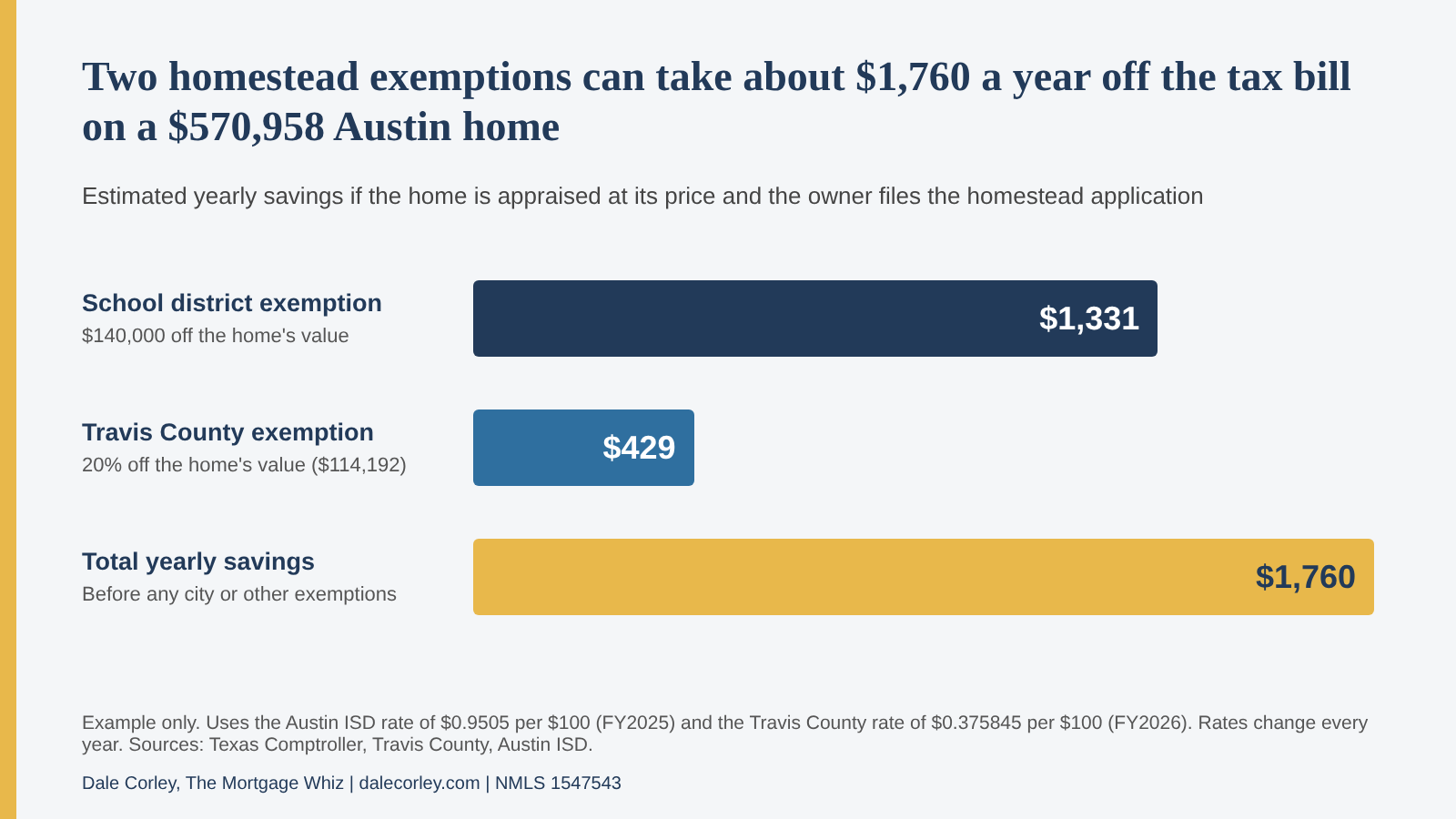
Caption: estimated yearly savings from two homestead exemptions on a $570,958 home, if the home is appraised at its price. Example only. Rates change every year.
Your appraisal district can tell you which exemptions your home qualifies for.
I already own a home. Can I use this to refinance?
Yes. The same bank statement documents can work for a refinance or a cash-out loan if you already own in Austin or the surrounding area. My cash-out refinance page is a good place to start, and you can always send me your scenario.
What do most loan officers miss with self-employed borrowers?
They miss the small things that stall a file late. Here are the ones I see most.
| What most people think | What I see | Why it matters |
|---|---|---|
| ”More months of statements are safer.” | 12 months is all I need. | Twelve months is much easier on you. |
| ”I need a letter from my accountant.” | An experienced bank statement loan officer knows how to clear that condition. | Call me before you chase your accountant. |
| ”Any account will do.” | One business and one account, and the name must match the statements exactly. | A mismatch can stall a file late. |
| ”My business is in another state, so I’m stuck.” | A short letter of explanation usually covers it. | You don’t have to move your company first. |
I fight the underwriter before I fight the borrower. If a condition looks wrong, I push back first.
Whiz Advice
Here is how I would play it in Austin:
- Get pre-approved before you tour. Most people find the house first. I’d rather know your number before you fall in love with one.
- Send me your returns and your statements together. I price both routes and tell you which one saves you more.
- Keep your deposits in one account. Twelve clean months are easy to document. Money bouncing between accounts is not.
- Ask for dollars, not a percent. In a buyer’s market, “$15,000” is clearer than “3%.”
- Claim your homestead exemption the first year you own. It lowers your bill, and it’s easy to forget. The property tax section above shows how.
Why use a mortgage broker?
Let hundreds of lenders compete for your loan. You fill out one application.
Shopping for a mortgage on your own means applying again and again, sending the same documents over and over, and waiting on every quote. I do that part for you.
Here’s how it works:
- Tell me your goals. I review them and structure your loan.
- I shop it. I enter your scenario into my loan search system. It checks hundreds of lenders, including most of the big banks and big lenders, and sorts them by rate, APR (the yearly cost of the loan, including fees), monthly payment or total cost.
- You get the best deal. If the lowest rate is your goal, I sort by rate, find the lender with the lowest rate at the moment you’re ready to lock, and lock it. Typically 350 or more lenders sit underneath with higher rates.
One application. One set of documents. Hundreds of lenders working for your business. I also make sure your application is accurate, so there are no surprises later.
How do you get ready to buy in Austin?
Here’s what you can do this week:
- Gather two years of tax returns and 12 months of bank statements. Send both, and I’ll tell you which route fits.
- Pay your credit cards down. Aim for under 10% of your limits, and no higher than 30%, so your debt-to-income ratio stays healthy.
- Get pre-approved before you shop. It tells you your price range and makes your offer stronger.
- Put everything on the application and tell me your concerns up front.
- Send me your numbers. My job is to find the loan program that fits your situation best and make sure the application is accurate. The bank statement income calculator is a good place to start.
Pick your next step:
- Ready to get pre-approved? Start your loan application. It’s the fastest way to find out what you can buy.
- Have a one-of-a-kind situation? Book a 15-minute call and we’ll talk it through.
- Just have a question? Email me at [email protected] with your scenario, and I’ll write back.
I’m a mortgage broker with NEXA Lending, and I work with borrowers all over Texas, including Austin. As a broker, I can shop your loan across hundreds of lenders instead of being stuck with one bank’s programs. Programs, rates and approval depend on your full file. This is educational and not tax or legal advice.
Sources: Central Texas Housing Report, September 2026, Redfin, Austin’s hottest neighborhoods of 2026, Oct 21, 2026, U.S. Census Bureau, Vintage 2025 estimates, Mar 26, 2026, Texas Comptroller, property tax exemptions, Texas Comptroller, valuing property, Texas Comptroller, property tax protests, Austin ISD, tax rates, Travis County FY2026 Taxpayer Impact Statement, Texas Comptroller, Texas has no state income tax, Dec 2025, California Franchise Tax Board, 2025 tax rate schedules, California Franchise Tax Board, 2025 Form 540-ES instructions, CFPB, what is a Qualified Mortgage.
Dale Corley | NMLS #1547543 | Licensed in CA, CO, TX, FL, GA, NC, SC, TN, VA | This is not a commitment to lend.