
Bank Statement Loans
The Complete Bank Statement Loan Guide for Self-Employed Borrowers
Dale Corley · 14 min read
By Dale Corley, mortgage broker with NEXA Lending, NMLS #1547543, 20 years in the business. Last reviewed October 7, 2026.
If you’re self-employed, your tax return and your bank account tell two different stories. A bank statement loan lets the bank account do the talking. I’ve used it for years to get business owners into homes that their tax returns alone wouldn’t support.
This guide is everything I know about it, in the order I’d explain it across my desk.
Key takeaways
- A bank statement loan qualifies you on 12 months of personal or business bank statements instead of tax returns.
- Business deposits are typically reduced by an expense factor, often about 50%. If 50% qualifies you, I don’t need anything else.
- I always read your tax returns first. A loan based on returns usually costs less.
- It’s a non-QM (non-traditional) loan, and in my experience the rate typically runs about 1% to 2% higher than a traditional loan.
- Most problems come from paperwork details: the wrong account, a name mismatch, an unlisted property or unexplained deposits.
In this guide: What it is · Key facts · Why it exists · Who it fits · Income math · Checking the cheaper option · Requirements · Fine print · Nuances · Uses · Mistakes · Is the rate worth it? · Preparing · For CPAs and agents · Glossary
What is a bank statement loan?
A bank statement loan is a mortgage that qualifies you on 12 months of personal or business bank statements instead of tax returns. I add up your deposits, divide by 12, apply an expense factor to business deposits, and compare the result to your monthly debts.
Most lenders call it a non-QM (non-traditional) loan. Here’s what that means:
- A Qualified Mortgage, or QM, is the CFPB’s category for a loan with safer features that make it more likely you can afford it.
- A non-QM (non-traditional) loan sits outside that box.
- It still has to meet the federal ability-to-repay rule, so the lender still verifies that you can afford the payment. It just uses different documents.
Because the lender takes on more risk, in my experience the rate typically runs about 1% to 2% higher than a traditional tax-return loan. That varies by file and by market, so treat it as my experience, not a quote.
Key facts at a glance
| Item | Typical in my experience |
|---|---|
| Income documentation | 12 months of personal or business bank statements |
| Business deposits counted | About 50%, lower when I can document it, higher for high-expense businesses |
| Personal deposits counted | 100% |
| Self-employment history | Two years, documented |
| Rate compared with a tax-return loan | Typically about 1% to 2% higher, sometimes about the same |
| Minimum down payment | Often around 10% with excellent credit |
| Reserves | Typically around 6 months, sometimes more on larger loans |
| Debt-to-income limits | Often 40% for housing and 50% for total debts |
| Property types | Primary, second home and investment |
| Loan purposes | Purchase, rate and term refinance, cash-out refinance |
These are ranges from the programs I work with. Credit and asset requirements change with investor appetite, so I confirm every number against your file.
Why do self-employed borrowers need a different loan?
Because conventional underwriting measures taxable income, and good tax planning shrinks taxable income. Loan officers qualify self-employed borrowers on one to two years of tax returns. Fannie Mae’s Selling Guide, for example, has lenders analyze the net profit on your return and adjust it for certain items.
The problem is that a growing business reports little profit because it reinvests, hires and expenses aggressively. Your CPA is doing their job. The lender who measures the return just sees a small number. A borrower can afford a $1,000,000 home comfortably and still qualify for only $500,000 on paper.
You’re not alone here. The Bureau of Labor Statistics counted about 9.5 million unincorporated self-employed workers in August 2026 (BLS Table A-8), and that doesn’t include incorporated business owners.
Who is a good fit for a bank statement loan?
Anyone who has been self-employed for two years or more and whose tax returns understate what the business really earns. In my experience that includes:
- Business owners: sole proprietors, LLC members and partners, S-corp and C-corp owners
- Franchise, restaurant, gym and dealership owners
- Real estate agents
- 1099 professionals: consultants, travelling nurses, independent physicians
- Transportation and delivery contractors
- Gig workers, e-commerce sellers and content creators with advertising income
- Low-margin or high-expense businesses
How is income calculated?
I average 12 months of deposits and apply an expense factor. Which statements you use changes the math.
| Business bank statements | Personal bank statements | |
|---|---|---|
| Ownership needed | As little as 50% in my experience | As little as 25% in my experience |
| Deposits counted | Reduced by an expense factor | Up to 100%, no expense factor |
| Accounts | One business, one account | All account holders must be on the loan |
| Transfers from the business | Not counted as revenue | Can count as income |
The most common expense factor is 50%. If 50% qualifies you, I don’t need anything else. Businesses with large payrolls, such as builders and restaurant owners with several locations, may be assigned a higher factor, up to about 70%, case by case.
If the income falls short and I need more, I can sometimes use a lower factor, and in my experience that can go as low as 25% in some programs.
A worked example
These are hypothetical numbers, not a program or payment I’m offering.
- A business account takes in $600,000 over 12 months, which is $50,000 a month.
- At a 50% expense factor, qualifying income is $25,000 a month.
- At a 35% factor, qualifying income would be $32,500 a month.
- At a 70% factor, qualifying income would be $15,000 a month.
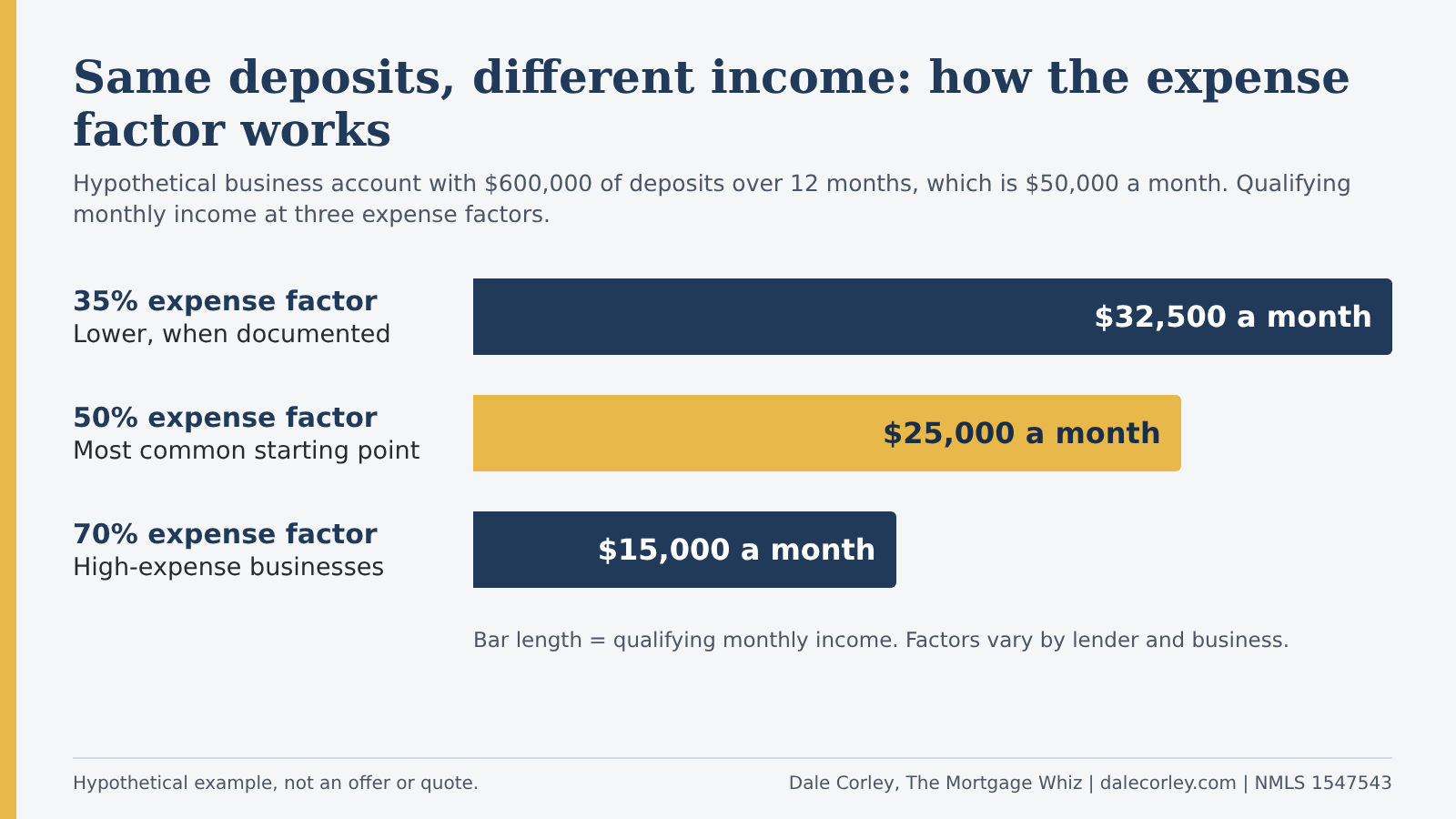
The expense factor is the most important lever in the file. Fifty percent is the usual starting point, and I only go lower when I need more income.
How do I check the cheaper option first?
I always read your tax returns before I recommend a bank statement loan. A loan based on returns usually has a lower rate, so I’d rather use it if it works.
Here’s the order I follow:
- Read the returns. I ask for the taxable income line on your personal return first. If you paid taxes on $120,000 of income, I know I have at least $10,000 a month to work with, and I see where that puts your debt-to-income ratio. If it’s close to 50%, I dig deeper.
- Check the one-year option. Freddie Mac allows a lender to use one year of returns instead of two when the business has been in existence for five years or more, according to Freddie Mac’s income documentation. Most business owners have never heard that.
- Look for add-backs. Fannie Mae tells lenders to add back recurring items such as depreciation, depletion, amortization, casualty losses and business use of the home. The bottom line on your return can understate your real income. I show how in Why Your Tax Write-Offs Are Hurting Your Mortgage Application.
- Use bank statements only if the returns don’t get you to the number you need.
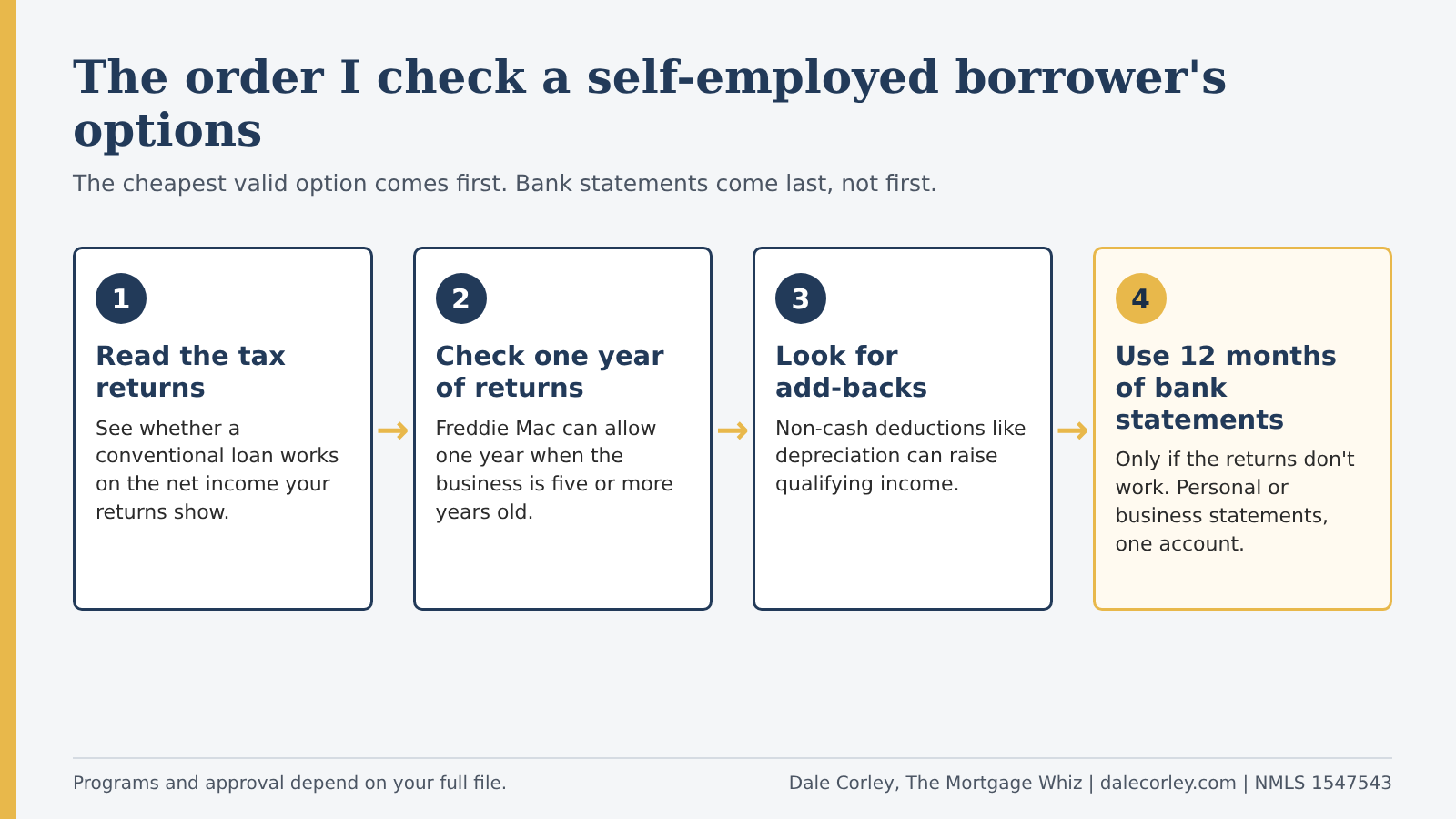
The cheapest valid option comes first. Bank statements come last, not first.
What are the requirements?
These are the ranges I see in a solid market. They change, and every lender differs.
| Requirement | What I typically see |
|---|---|
| Credit score and down payment | Sample grid: 640 score may need 20% down, 660 may need 15%, 700 may need 10%. A 95% loan-to-value is very rarely available |
| Debt-to-income | Often 40% for the housing payment and 50% for all debts including the new payment |
| Self-employment history | Two years, documented with a business license, articles of incorporation or a tax preparer letter |
| Ownership | Proof of your percentage: articles with an operating agreement stating ownership, a K-1 from your most recent business return, or a tax preparer letter |
| Loan amounts | About $150,000 up to about $3,000,000, higher possible at lower loan-to-value. Two appraisals are typically required above $1,500,000 |
| Mortgage insurance | In the programs I use, no monthly mortgage insurance is required above 80% loan-to-value |
| Past credit events | A foreclosure, short sale, bankruptcy or deed in lieu typically requires two years of seasoning |
I explain why two credit score points can matter in Credit Score and Mortgage Pricing: What Moves the Needle.
What are the fine print items that can sink a loan?
These nuances can stall a file as closing approaches. Most can be solved with compensating factors if I know about them early.
- Payment shock. Some lenders don’t want the new payment, including taxes, insurance and HOA, to exceed about 250% of a first-time buyer’s current rent, or about 350% of a current homeowner’s payment. Going from $2,000 a month to $10,000 is high risk.
- Tradelines. Typically three open accounts with 12 months of history, or two with 24 months, with some activity in the last 12 months.
- Reserves. Usually around 6 months, and sometimes 6 to 18 months depending on loan size and loan-to-value. Retirement accounts can count if there’s no waiting period to liquidate them, and business account balances can sometimes be used.
- Housing history. Renters need 12 months of verifiable rent, from bank statements or cancelled checks. Typically only one 30-day late payment is allowed in the last 12 months.
- Real estate owned. Every residential property you own has to be disclosed. Lenders will find them in due diligence, and the added payments can push you over the debt-to-income limit.
- One business, one account. The business name on the application has to match the statements exactly.
- Escrows. Escrowing taxes and insurance can sometimes be waived, but there may be a fee, around 0.25% of the loan amount in my experience.
- Hybrid income. If you or your spouse also have W-2 income, I can often combine it with the bank statement income.
What are compensating factors?
Many guidelines above are not hard stops. If you run into payment shock, a tradeline problem, or even less than two years of self-employment, an experienced loan officer can sometimes get an underwriting exception using compensating factors. In my experience these include:
- a high credit score
- 12 or more months of reserves
- a low debt-to-income ratio
- a long record of business stability
- a low loan-to-value
For someone who moved from a W-2 job to 1099 work, a well-written letter of explanation helps, and the move should show up on your tax returns. Nothing here is a promise. Each lender decides.
What nuances do most loan officers miss?
Bank statement loans have a lot of small details. A loan officer who avoids these loans, or fears them, rarely learns the details, and the borrower pays for it.
| What most people think | What I see | Why it matters |
|---|---|---|
| You need 24 months of statements | 12 months does the same job in today’s market | It’s the difference between running a half marathon and a full marathon |
| Rates are always 2% higher | Typically 1% to 2% higher, and sometimes about the same | Compare real quotes, not rules of thumb |
| Business and personal statements work the same | Personal deposits can count at 100%, but every account holder must be on the loan | Choosing the right account changes your income |
| You can use any account | One business and one account, and the name must match exactly | Mixed accounts are the most common reason income gets cut |
Why rates can match. In my experience, conventional rates tend to follow the 10-year Treasury, while non-QM (non-traditional) bank statement pricing tends to follow shorter-term rates like the 2-year. When the yield curve flattens or inverts, the gap can close. In September and October 2026, my own bank statement pricing has been close to conforming conventional pricing. That changes with the market, so ask for current quotes on both.
What can I use a bank statement loan for?
Purchases, rate and term refinances and cash-out refinances, on primary residences, second homes and investment properties.
Interest-only option. Some borrowers in high-priced areas, or who expect lower cash flow, choose interest-only. In my experience one common structure is a 40-year loan that’s interest-only for the first 10 years and then amortizes, and the rate bump is small, around a quarter to a half point. The payment rises when the interest-only period ends, so plan for it.
Paid cash for a home? A buyer who paid cash can sometimes refinance to get the money back. In my experience, after six months of ownership the new appraised value can be used, with cash back of up to 85% of value depending on the lender and file.
What mistakes slow these loans down?
The big ones are mixing business and personal money, a name that doesn’t match the statements, undisclosed properties, unexplained deposits, thin credit and large payment shock. I go through each one in 7 Bank Statement Mistakes That Slow Underwriting, and the account-matching problem in What Is a Bank Statement Loan and How Does It Work?.
A pattern I see (hypothetical). A borrower is turned down by his bank days before closing, because the pre-approval was never run through underwriting. He and his agent find me with a closing date approaching. Sometimes a bank statement loan turns that around, and sometimes it can’t be done by the original date. No one can promise the date.
Is a higher rate worth it?
It’s a fair question, and I’d rather you ask it. In my experience the premium is typically 1% to 2%, and sometimes there’s none. Many borrowers talk it over with a financial advisor and conclude the tax savings are worth more than the extra rate. Others plan to prepare their taxes differently for one or two years and refinance later.
How do I prepare?
- Gather 12 months of statements for the account that holds your income.
- Mark every non-revenue deposit, such as transfers, loans and refunds.
- Gather proof of ownership.
- Document two years of self-employment.
- List every property you own, including those in entities.
- Document 12 months of housing payments.
- Count your reserves, including retirement and business accounts.
- Send me your last two tax returns so I can check the cheaper option first.
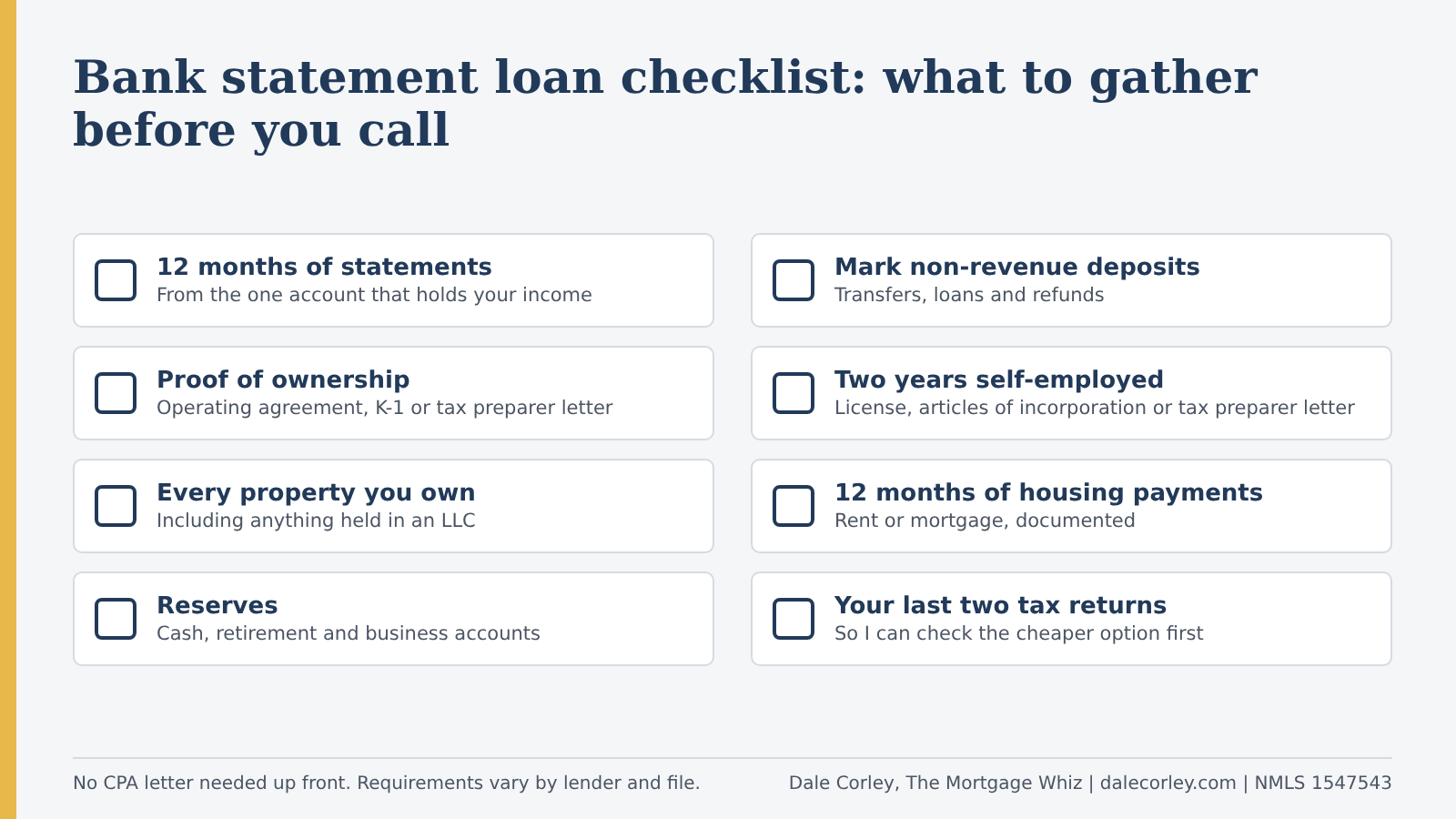
Save or print this checklist before your first call. Requirements vary by lender and file.
You can run a first estimate with my bank statement income calculator, read the bank statement loan program page, or look up terms in my glossary entry for non-QM (non-traditional) loans.
For CPAs and real estate agents: what to tell your client
If you work with self-employed clients, these four points will save them time:
- Tax returns and mortgage qualifying pull in opposite directions. Aggressive write-offs lower the income a conventional lender can count.
- There’s a program built for this. A bank statement loan qualifies on 12 months of deposits, and 12 months is enough.
- Timing matters. If a client plans to buy within a year or two, talk about the tradeoff before the return is filed. I can’t give tax advice, and neither choice is automatically right.
- Send them before the offer. A client who sends me statements before writing an offer has far more options than one who sends them after the contract is signed.
Plain-English glossary
| Term | What it means |
|---|---|
| Non-QM (non-traditional) loan | A mortgage outside the CFPB’s Qualified Mortgage category that still has to meet the ability-to-repay rule |
| Expense factor | The percentage of business deposits a lender assumes goes to expenses |
| Debt-to-income ratio (DTI) | Your monthly debts divided by your monthly income |
| Loan-to-value (LTV) | The loan amount divided by the property value |
| Reserves | Cash and liquid assets left after closing, counted in months of payments |
| Tradelines | Active credit accounts on your credit report |
| Payment shock | The jump from your current housing payment to the new one |
| Seasoning | The waiting period after a foreclosure, short sale or bankruptcy |
| Compensating factors | Strengths in your file that can offset a weak spot |
How to cite this guide
If you’re a CPA, real estate agent or financial professional and you want to reference this guide, please link to this page and credit Dale Corley, NMLS #1547543. I update it when guidelines change, and the review date at the top shows when it was last checked.
I’m a mortgage broker with NEXA Lending, and I work with borrowers in all nine states where I’m licensed (CA, CO, TX, FL, GA, NC, SC, TN, VA). As a broker, I can shop your loan across a wide network of lenders instead of being stuck with one bank’s programs. Programs, rates and approval depend on your full file, and individual rates vary.
Sources: Freddie Mac, Income Calculator FAQ (one year of returns for a business in existence five or more years), Fannie Mae Selling Guide B3-3.3-03, Schedule C add-backs, CFPB, What Is a Qualified Mortgage, BLS, Table A-8. Program ranges described here are the author’s professional experience and vary by lender.
Dale Corley | NMLS #1547543 | Licensed in CA, CO, TX, FL, GA, NC, SC, TN, VA | This is not a commitment to lend.