
Bank Statement Loans
Bank Statement Loan Requirements: Credit Score, Down Payment and Reserves
Dale Corley · 7 min read
Nobody in Washington decides what credit score, down payment or reserves you need for a bank statement loan. The investor behind the loan decides, which is why the answer changes from one lender to the next. In my experience the typical range is a credit score starting around 640, 10% to 20% down, and about six months of reserves.
Last reviewed October 14, 2026
Key takeaways
- No federal rule sets a minimum credit score, down payment or reserve amount for these loans. Each investor sets its own grid.
- The three trade off. In my experience a higher credit score can lower the down payment, and a smaller down payment can mean more reserves.
- Reserves are counted in months of your full housing payment, and they are the requirement that catches people most often.
- Most of these requirements are not hard stops. Compensating factors can clear many of them.
What the law requires · Credit score and down payment · Reserves · Other requirements · Nuances · Checklist
What does the law actually require?
The federal rule asks the lender to prove you can afford the loan, and that is all. It doesn’t set a score, a down payment or a reserve number.
Most lenders call these non-QM (non-traditional) loans. A Qualified Mortgage, or QM, is the CFPB’s category for a loan with safer features that make it more likely you can afford it. A non-QM (non-traditional) loan sits outside that box but still has to meet the federal ability-to-repay rule. It just proves income with different documents.
Because the lender takes on more risk, in my experience the rate typically runs about 1% to 2% higher than a traditional loan, and it varies by file and market.
Under the ability-to-repay rule, a lender has to consider eight things: your income or assets, your employment status, the new payment, any simultaneous loan, mortgage-related costs like taxes and insurance, your other debts, your debt-to-income ratio or residual income, and your credit history. Credit history and assets are on the list, but the rule gives no number for either.
That is the edge most borrowers never hear. A requirement like “640 and 20% down” isn’t a law. It’s one investor’s risk grid, and the next investor’s grid can look different.
How do credit score and down payment work together?
They work as a trade. A higher credit score usually buys you a smaller down payment, and a lower score asks for more cash at the table.
Here’s a sample grid from the programs I work with. It’s an illustration of how these grids behave, not an offer, and every lender is different.
| Credit score | Typical minimum down payment | Down payment on a $600,000 home |
|---|---|---|
| 640 | 20% | $120,000 |
| 660 | 15% | $90,000 |
| 700 | 10% | $60,000 |
On a hypothetical $600,000 purchase, the gap between a 640 score and a 700 score is $60,000 of down payment. That is why a few points can matter on this type of loan. I go deeper on pricing in Credit Score and Mortgage Pricing: What Moves the Needle.
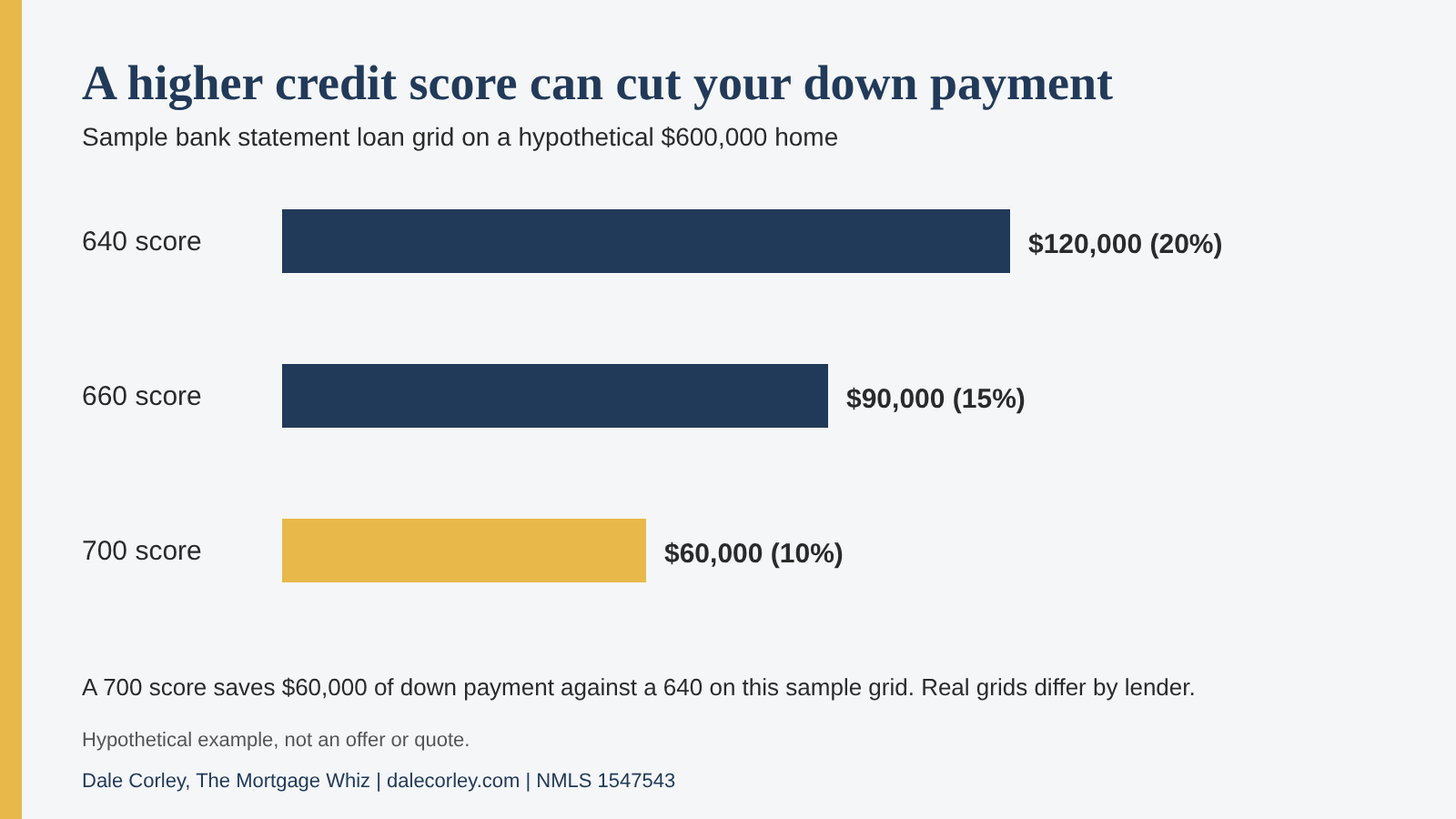 A sample grid on a hypothetical $600,000 home. Real grids differ by lender.
A 95% loan-to-value, meaning only 5% down, is very rarely available on these loans. In my experience 10% is the usual floor for a primary residence.
What are reserves and how many do I need?
Reserves are the money left in your accounts after you close. The lender counts them in months of your full housing payment, which includes principal, interest, taxes, insurance and any HOA dues.
In my experience about six months is typical, and larger loans can require more. Retirement accounts and business accounts can sometimes count, which is worth knowing before you assume you fall short.
Here’s a hypothetical with simple math. It’s not a program or payment I’m offering.
- Your total housing payment is $4,400 a month.
- Six months of reserves is $26,400.
- Twelve months, which can happen on a larger loan, is $52,800.
- With 10% down on a $600,000 home, you need $60,000 for the down payment plus $26,400 in reserves, or $86,400. That is before closing costs.
The reserves surprise is real, and I’ll show you how it plays out below.
What other requirements should I know about?
Beyond the big three, a handful of items come up on almost every file. All of these are typical ranges that vary by lender.
- Income documents: 12 months of personal or business bank statements. Personal deposits can count at 100%, and business deposits get reduced by an expense factor, often about 50%.
- Self-employment history: Usually two years, documented with a business license, articles of incorporation or a similar record.
- Housing history: 12 months of rent you can document.
- Tradelines: Three open accounts with 12 months of history, or two open for two years.
- Debt-to-income: Often around 40% for the housing payment and 50% for all debts, depending on the program.
If you want to see how your deposits turn into income, try my bank statement income calculator. The full process is in my Complete Bank Statement Loan Guide.
Should I check a conventional loan first?
Yes. I read your tax returns before I look at bank statements, because the cheapest valid option comes first.
Conventional loans follow published rules. For example, Fannie Mae’s guide says a minimum credit score is not required for loans run through its Desktop Underwriter system, and manually underwritten loans need a 620 on a fixed-rate loan. Freddie Mac can sometimes accept one year of tax returns instead of two when the business has existed at least five years, a route many business owners have never heard of.
If those options work, you use them. If your write-offs push the return income too low, that’s when bank statements make sense. That order is the whole point of having a broker who knows both paths.
What nuances do most loan officers miss?
These are small details that decide whether a file closes. A loan officer who avoids these loans rarely learns them.
| What most people think | What I see | Why it matters |
|---|---|---|
| The minimum score is the score you need | The score sets the down payment and pricing on a grid | A 700 can save you $60,000 of down payment against a 640 |
| Reserves are just extra cushion | They are counted in months of your whole payment, and retirement and business accounts can sometimes count | Many borrowers don’t know what counts until late in the process |
| You need years of statements | 12 months of statements does the job | You don’t have to dig up more history than the file needs |
| Guidelines are hard stops | Compensating factors can clear many guideline issues | A strong score, extra reserves or a low debt-to-income ratio can offset a weak spot |
| New payment just needs to fit | Some lenders cap payment shock around 250% of a first-time buyer’s current rent or 350% of a homeowner’s payment | Going from $2,000 rent to a $10,000 payment can stall a file |
When an underwriter raises a condition, I fight the underwriter before fighting the borrower. If a requirement is a lender overlay and not a real rule, I can often take the file to a different investor.
A pitfall I see: the reserves surprise
This is a hypothetical, but I see this pattern a lot.
A restaurant owner has strong deposits and a 700 credit score. She plans for 10% down on a $600,000 home and saves exactly $60,000. Her lender says the program also needs six months of reserves, which on her $4,400 payment is $26,400.
Her cash is already committed to the down payment, and most of her wealth is tied up in the business. With closing a few weeks away, she’s scrambling to find $26,400 she hadn’t planned on.
If she’d told me on day one, I’d have checked whether her retirement and business accounts could count toward reserves, and I’d have looked at investors with different reserve requirements. That’s the value of asking early. A broker with a wide network can shop that grid, and in my experience I can usually move faster than a big bank when the clock is running. Nobody can promise the original closing date on a rescue, though.
What should I do before I call?
- Check your credit score so we know where you sit on the grid.
- Add up your cash, including retirement and business accounts, so we know what can go toward the down payment and what can count as reserves.
- Pull 12 months of bank statements for the account that carries your business income.
- List every property you own and every monthly debt.
- Document 12 months of rent if you’re currently renting.
- Have your last two tax returns handy so I can check the cheaper option first.
I’m a mortgage broker with NEXA Lending, and I work with borrowers in all nine states where I’m licensed (CA, CO, TX, FL, GA, NC, SC, TN, VA). As a broker, I can shop your loan across a wide network of lenders instead of being stuck with one bank’s programs. Send me your numbers and I’ll tell you where you fit. Programs, rates and approval depend on your full file.
Sources: CFPB, What Is a Qualified Mortgage, eCFR, 12 CFR 1026.43, Minimum standards for transactions secured by a dwelling, Fannie Mae Selling Guide B3-5.1-01, General Requirements for Credit Scores (April 22, 2026), Freddie Mac, Income Calculator FAQ. Grids, reserve ranges and payment figures are my experience and hypothetical math calculated by the author.
Dale Corley | NMLS #1547543 | Licensed in CA, CO, TX, FL, GA, NC, SC, TN, VA | This is not a commitment to lend.