
Bank Statement Loans
Bank Statement Loan Requirements: Credit Score, Down Payment and Reserves
Dale Corley · 8 min read
A bank statement loan typically requires a credit score somewhere between 640 and 700 or higher, a down payment of 10% to 20% depending on that score, and about six months of reserves. Those are the ranges I see in a solid market. They change, and every lender sets its own.
Last reviewed October 14, 2026
The number most borrowers focus on is the down payment. It’s the wrong number. The one that actually stops files is the total cash you have to show, and most people don’t add it up until I do it for them.
Key takeaways
- Typical ranges from my files: credit score 640 to 700+, down payment 10% to 20%, reserves about 6 months, sometimes more on larger loans.
- The credit score and the down payment move together. A lower score usually means more cash down.
- Reserves are counted in months of your full new payment, including taxes and insurance.
- On a hypothetical $750,000 purchase, total cash needed runs about $131,000 to $206,000, depending on the down payment.
- Retirement accounts and sometimes business balances can count toward reserves.
The requirements · The edge: total cash · Credit score · Reserves · Nuances · Checklist
What are the requirements for a bank statement loan?
Here are the ranges I typically see. They vary by lender and by file, and none of this is a quote.
| Requirement | What I typically see |
|---|---|
| Income documents | 12 months of personal or business bank statements |
| Credit score and down payment | A sample grid: 640 may need 20% down, 660 may need 15%, 700 may need 10% |
| Reserves | About 6 months, sometimes more on larger loans |
| Debt-to-income (DTI) | Often 40% for the housing payment and 50% for all debts, new payment included |
| Self-employment history | Two years, documented with a business license, articles of incorporation or a tax preparer letter |
| Housing history | 12 months of verifiable rent or mortgage payments |
Most lenders call these non-QM (non-traditional) loans. A Qualified Mortgage, or QM, is the CFPB’s category for a loan with safer features that make it more likely you can afford it. A non-QM (non-traditional) loan sits outside that box but still has to meet the federal ability-to-repay rule. It just proves income with different documents.
Because the lender takes on more risk, in my experience the rate typically runs about 1% to 2% higher than a traditional loan, and it varies by file and market.
Debt-to-income, or DTI, is your monthly debts divided by your monthly income. My bank statement income calculator shows how your deposits turn into qualifying income.
How much cash do I really need?
You need your down payment, your closing costs and your reserves, all at once. That total is usually far bigger than the down payment alone.
Reserves are the cash and liquid assets you still have after closing. Lenders count them in months of your full housing payment: principal, interest, taxes and insurance. That’s the part people miss. Six months of reserves isn’t six months of your rent. It’s six months of the new payment.
Here’s a hypothetical. It’s not an offer, a payment or a program. I’m assuming a $750,000 purchase, a $6,000 monthly payment including taxes and insurance, and $20,000 in closing costs. Closing costs vary a lot by state and loan.
| Credit score and down payment | Down payment | Closing costs | 6 months of reserves | Total cash needed |
|---|---|---|---|---|
| 700 with 10% down | $75,000 | $20,000 | $36,000 | $131,000 |
| 660 with 15% down | $112,500 | $20,000 | $36,000 | $168,500 |
| 640 with 20% down | $150,000 | $20,000 | $36,000 | $206,000 |
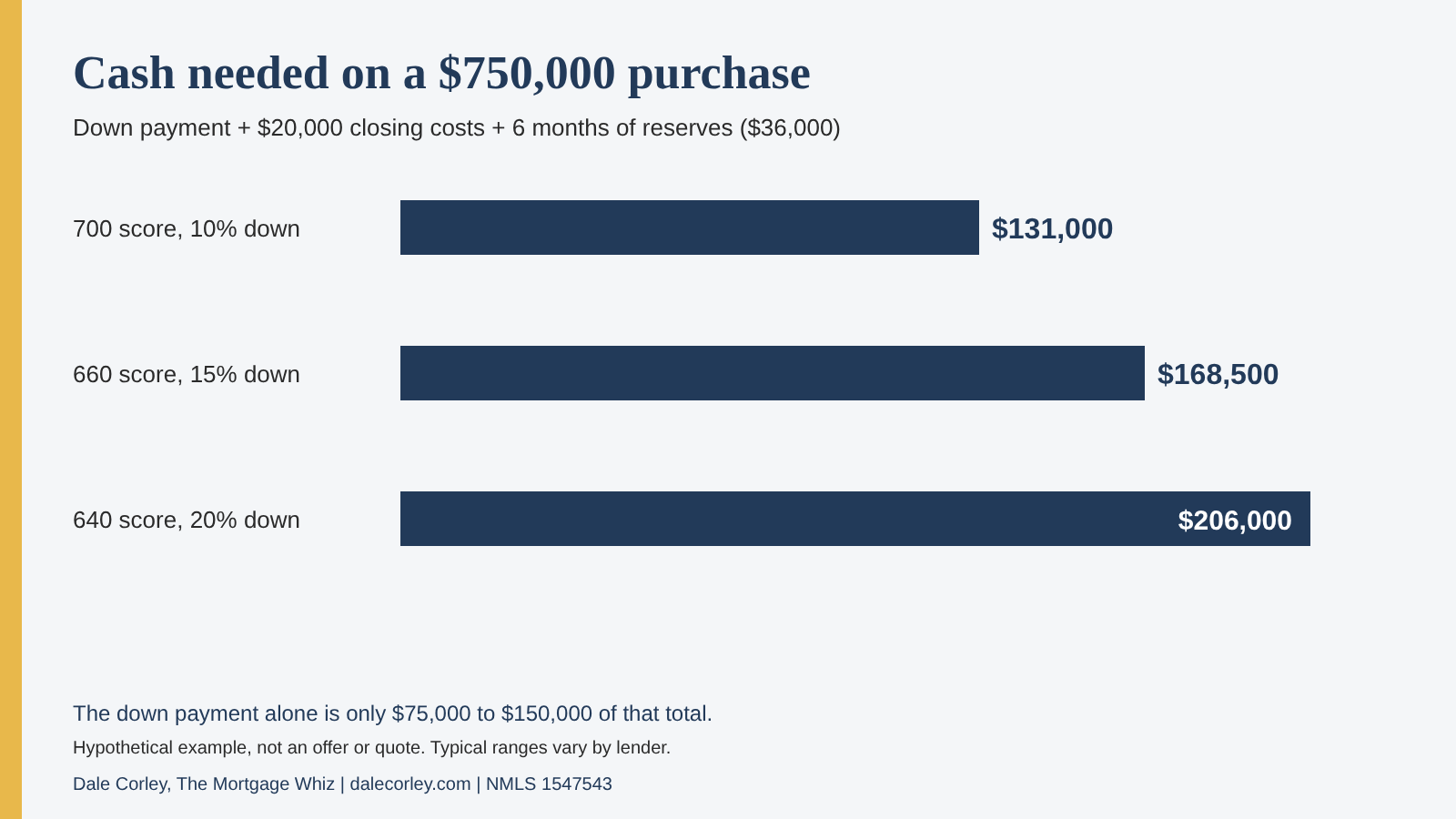
Hypothetical example, not an offer. The down payment is only 57% of the cash needed in the first row.
Now say the lender wants 12 months of reserves on a bigger loan. That’s $72,000 instead of $36,000. At 18 months it’s $108,000. The same 10% down purchase now needs $167,000 or $203,000 in total. I run this math on the first call, before anyone falls in love with a house.
What credit score do I need?
Most bank statement programs start around 640, and the better pricing and lower down payments tend to start at 700 and above. The grid above is a sample, not a rule. Your exact score, your loan-to-value and the loan size all move it.
Loan-to-value, or LTV, is your loan divided by the home’s value. A 10% down payment means a 90% LTV. Lenders set their lowest down payment for the strongest scores, so a score that’s a few points short can move you into a different down payment tier.
That’s why the two numbers have to be read together. I explain how small score differences change pricing in Credit Score and Mortgage Pricing: What Moves the Needle. A foreclosure, short sale, bankruptcy or deed in lieu typically needs about two years of seasoning.
How does my income fit the DTI limit?
Your qualifying income sets the largest payment you can carry, and the 40% housing limit hits fast. Take the same hypothetical buyer.
Say her business account takes in $360,000 over 12 months, which is $30,000 a month. At a typical 50% expense factor, her qualifying income is $15,000 a month. Forty percent of that is $6,000, exactly the payment in the example above. The 50% total DTI cap gives her $7,500 for all debts, which leaves $1,500 for her car payment and everything else.
That works on paper but leaves no breathing room. If she carried $2,000 a month in other debts, the same loan would break the total DTI cap. I check this first, because debt, not cash, is sometimes the real limit.
Business statements are reduced by an expense factor, and personal statements can count deposits at 100% when every account holder is on the loan. Choosing the right account can change the answer, which I cover in the complete bank statement loan guide.
What counts as reserves?
Cash in checking and savings counts. In my experience, retirement accounts can count if there’s no waiting period to liquidate them, and business account balances can sometimes be used. Each lender decides, so I ask before a borrower moves any money around.
Don’t move money around on your own. A large transfer, even between your own accounts, gives underwriting one more thing to ask about.
What nuances do most loan officers miss?
Loan officers who avoid these loans rarely learn the small details, and the borrower pays for it.
| What most people think | What I see | Why it matters |
|---|---|---|
| The down payment is the main hurdle | Down payment, closing costs and reserves all have to be there | A borrower who budgets only for the down payment can be short when I add up the total |
| You need 24 months of statements | 12 months does the same job in today’s market | It’s the difference between running a half marathon and a full marathon |
| A low score means no deal | Compensating factors can clear many guideline issues | A strong DTI, extra reserves or a long business history can offset a weak spot |
| Rates are always 2% higher | Typically 1% to 2% higher, and sometimes about the same | Compare real quotes, not rules of thumb |
Compensating factors are strengths that offset a weak spot in your file. In my experience they include a high score, 12 or more months of reserves, a low DTI, a long record of business stability and a low loan-to-value. Nothing here is a promise. Each lender decides.
A pitfall I see: the reserves surprise
This is a hypothetical, but it’s a pattern I see a lot.
A restaurant owner has a strong year of deposits and a 700 score. He’s saved $90,000 and plans to put 10% down on a $750,000 home. He thinks he’s covered with $15,000 to spare.
Then closing costs come in, and the lender asks for six months of the new payment on top. That’s another $36,000 he didn’t plan for, and he’s now short. His retirement account might cover it, but only if the lender counts it and he can access it without a waiting period.
The fix is to add up the total before you make an offer, not after. Count cash, retirement and business balances, and ask what each one can contribute. I’d rather find the gap on day one, because I can often fix it with a different down payment tier or a different program. If I find it three weeks into escrow, there’s less I can do.
What should I do before I call?
- Pull 12 months of statements for the account that holds your business income.
- Check your credit score and note any late payments in the last 12 months.
- Add up your cash, retirement and business balances so we know your reserves.
- List every monthly debt, including the ones that feel small.
- Gather 12 months of rent or mortgage payments, with proof.
- Dig out your last two tax returns. I check the cheaper option first. That can include Freddie Mac’s one-year return option when the business has existed five years or more.
I move fast. In my experience, as a broker I can usually turn a file quicker than a large bank can, and speed is one of the things that separates me. Send me your numbers and I’ll tell you whether the cash, the credit and the income all line up before you spend a dollar on an appraisal.
I’m a mortgage broker with NEXA Lending, and I work with borrowers in all nine states where I’m licensed (CA, CO, TX, FL, GA, NC, SC, TN, VA). As a broker, I can shop your loan across a wide network of lenders instead of being stuck with one bank’s programs. Programs, rates and approval depend on your full file, and individual rates vary.
Sources: CFPB, What Is a Qualified Mortgage, Freddie Mac, Income Calculator FAQ. Ranges for credit score, down payment, reserves and DTI are typical figures from my own experience and vary by lender.
Dale Corley | NMLS #1547543 | Licensed in CA, CO, TX, FL, GA, NC, SC, TN, VA | This is not a commitment to lend.