
Mortgage Tips
Home Equity Playbook: HELOC, Home Equity Loan or Cash-Out Refinance
Dale Corley · 11 min read
Pick a HELOC if you’ll borrow in stages, a home equity loan if you want one lump sum at a fixed rate, and a cash-out refinance only when your current mortgage rate is already close to today’s. If your rate is lower than today’s, you usually don’t want to touch it.
I’m a mortgage broker, so I shop hundreds of lenders and you don’t have to. Send me your balance, your rate and what you want the money for, and I’ll show you all three side by side. This guide explains how each one works and costs, with one example worked out in dollars.
More homeowners are asking. CNBC reported in October that homeowners took out nearly 20% more second mortgages and HELOCs in the second quarter than in the first. And 65.6% of outstanding mortgages carry a rate under 5%, according to Realtor.com’s second-quarter data as reported by HousingWire. The average 30-year fixed rate was 7.24% in October, per Freddie Mac. Your old rate is worth protecting.
Key takeaways
- A HELOC is a credit line you draw from. A home equity loan is one lump sum at a fixed rate. Both sit behind your current mortgage and leave it alone.
- A cash-out refinance replaces your whole mortgage. In my example, it raises your payment by $1,278 a month to borrow $100,000. A HELOC or home equity loan raises it by $625 to $836.
- Many lenders let your total borrowing reach about 80% of your home’s value. Some go higher. Your limit depends on your credit and income.
- You can move up without selling: rent out the old house, pay its loan down faster, or sell with seller financing if you own it outright.
- I shop hundreds of lenders, so you don’t have to.
On this page: Which is better · How much equity · HELOC · Home equity loan · Cash-out refinance · The dollars · Pay off cards · Move up · Whiz Advice
HELOC vs home equity loan vs cash-out refinance: which one is better?
It depends on your current rate and your goal. If your rate is lower than today’s, a HELOC or home equity loan lets you borrow without giving it up. Here is how the three compare.
| HELOC | Home equity loan | Cash-out refinance | |
|---|---|---|---|
| What it is | A credit line you draw from | One lump sum | A new, bigger mortgage |
| Your current mortgage | Stays | Stays | Replaced |
| Rate | Usually variable | Fixed or variable | Usually fixed |
| How you get the money | Draw as you need it | All at closing | All at closing |
| Best for | Costs spread over time | One known cost | When your rate is already high |
The CFPB calls both a HELOC and a home equity loan a second mortgage when you already have a first one. You pay both each month. A cash-out refinance has just one payment.
How much of my home equity can I use?
Equity is your home’s value minus what you owe. Say your home is worth $900,000 and you owe $330,000. Your equity is $570,000.
Lenders look at your combined loan-to-value ratio, or CLTV. That is all your mortgage debt added together, divided by your home’s value. Many lenders stop at about 80%, and some go higher. It varies by lender, loan type and credit.
At 80%, the most you could borrow in total is $720,000. Subtract the $330,000 you owe, and you could add up to $390,000. In my example below, I borrow $100,000. That brings the CLTV to about 48%.
How does a HELOC work?
A HELOC, or home equity line of credit, works like a credit card with your home behind it. You get a limit, and you borrow from it when you need to. Repay it, and the room opens up again.
The CFPB describes two phases. In the draw period, which can last about 10 years, you borrow and often pay only interest. In the repayment period, which usually runs 10 to 20 years, you can’t borrow anymore and the payments are often much higher.
Most HELOCs have a variable rate, so your payment can change. Some let you lock part of the balance at a fixed rate. HELOC rates follow the prime rate, which was 7.00% in October 2026 (Federal Reserve data on FRED). For my example I used prime plus 0.50%, or 7.50%. Your margin depends on your credit and loan size.
On $100,000 at 7.50%, the interest-only payment is $625 a month. When repayment starts, a 20-year payoff costs about $806 a month.
How does a home equity loan work?
A home equity loan gives you the whole amount at closing. You repay it in equal monthly payments over a set number of years. The CFPB says the rate can be fixed or adjustable.
The big plus is that you know your payment on day one. For my example I used $100,000 at 8.00% fixed over 20 years, which is $836 a month. That rate is an example, and real rates vary by lender and file.
When does a cash-out refinance make sense?
A cash-out refinance makes sense when your current rate is already close to today’s or above it. You replace your mortgage with a bigger one and take the difference in cash. The whole balance moves to the new rate.
The 30-year fixed average was 7.24% and the 15-year was 6.60% in October (Freddie Mac). In my experience, cash-out loans often price a little above the average. I used the average to keep the comparison fair. Most lenders cap a cash-out loan at around 80% of your home’s value on a main home.
Look at what happens to a 3.5% loan. In my example, $330,000 of the new $430,000 is money you already owe. Moving it from 3.5% to 7.24% on a new 30-year loan raises that part of your payment from $1,652 to $2,249, before you take out a dollar.
If your rate is 7% or more today, this is often the cleanest route. If it’s 3.5%, I look at the other two first.
What does each option cost on the same $100,000?
Here is one example, not a quote. Your home is worth $900,000. You owe $330,000 at 3.5%, with 25 years left, and your payment is $1,652 a month. You want $100,000.
| Option | Rate used | Change from today’s $1,652 | Your total monthly payment |
|---|---|---|---|
| Keep your loan, add a HELOC (interest only) | 7.50% variable | +$625 | $2,277 |
| Keep your loan, add a home equity loan (20 years) | 8.00% fixed | +$836 | $2,489 |
| Cash-out refinance: new $430,000 loan (30 years), replaces your old loan | 7.24% fixed | +$1,278 | $2,930 |
With the cash-out loan, your $1,652 payment goes away. The $2,930 is one new payment on the whole $430,000, so the $1,278 is the difference from today, not an add-on. When the HELOC moves to repayment, its payment rises to about $806, or $2,458 in total. The cash-out loan is spread over 30 years and the home equity loan over 20, so read this table as a monthly snapshot, not a total-cost comparison.
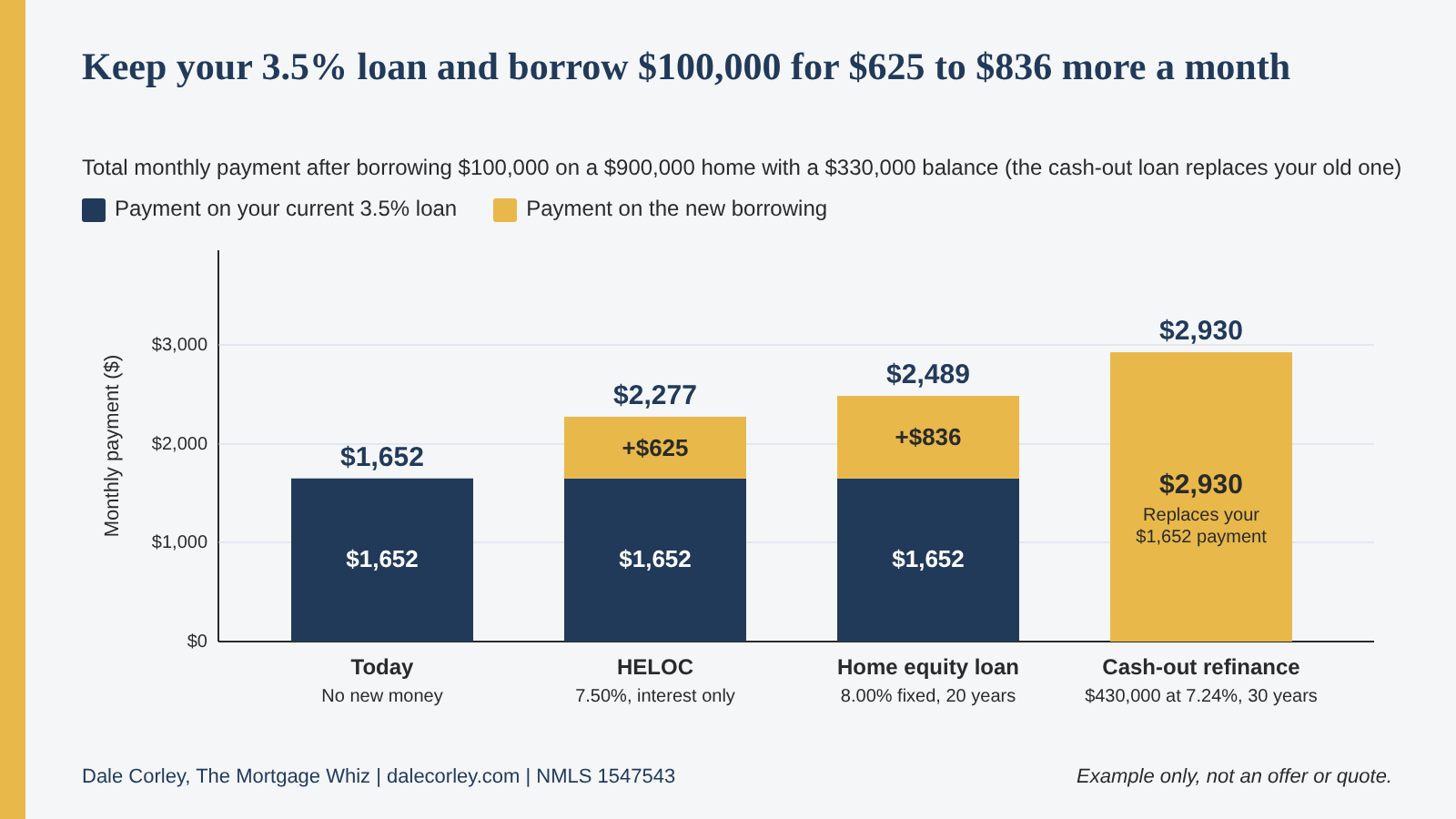 Keeping your 3.5% loan costs $625 to $836 more a month for $100,000. The cash-out loan replaces your $1,652 payment with $2,930, which is $1,278 more.
Can I use home equity to pay off credit cards?
Yes, and it’s the clearest dollar win I see. The Federal Reserve reports an average credit card rate of 22.15% on accounts that pay interest (second quarter 2026). On $40,000 of card debt, that’s about $8,860 a year in interest. At the 7.50% HELOC rate in my example, the interest is $3,000. You save about $5,860 a year, or $488 a month.
The trade-off is the home. A card balance isn’t tied to your house, and a HELOC is. The CFPB warns that falling behind on a HELOC could cost you your home. I only like this move when the cards stay at zero afterward.
How can I move up without giving up my low rate?
Selling your home means giving up the rate you have. You have three ways to avoid that.
Can I rent out my current home and buy the next one?
Yes, and a lender can count part of the rent. Here is how Fannie Mae’s rule works for the home you’re leaving. It does not accept a lease for this. Instead, the rent is backed by an appraisal with market rents or a rent survey of at least three comparable rentals. The lender counts 75% of that rent, then subtracts the full payment on the old home (principal, interest, taxes and insurance). If the result is positive, it offsets that payment so the old home doesn’t count against you. If it’s negative, it counts as debt. If you have less than 12 months of experience managing rentals, you need six months of that payment saved as reserves.
Example: market rent of $3,800 times 75% is $2,850. Your old home’s payment is $2,252 ($1,652 plus an example $600 for taxes and insurance). The $598 left over offsets the payment but can’t be used as extra income. Other loan programs set their own rules, so send me your numbers first.
Can I pay off my low-rate loan faster?
Yes, and you don’t need to refinance to do it. Send extra money with each payment and mark it as principal. Your required payment stays at $1,652, which is the number the next lender counts.
| Payoff time | Monthly payment | Extra each month | Interest left to pay |
|---|---|---|---|
| 25 years (today) | $1,652 | $0 | $165,617 |
| 15 years | $2,359 | $707 | $94,640 |
| 10 years | $3,263 | $1,611 | $61,588 |
Rent from the old home can cover part of that extra. Paying the loan off in 10 or 15 years leaves you with a paid-off rental.
Can I sell my home with seller financing?
Sometimes. With seller financing, you sell the home and act as the bank. The buyer pays you each month instead of borrowing from a lender. Say you sell for $900,000, and the buyer puts 20% down ($180,000). You finance $720,000 at 6%. The buyer pays $4,317 a month, versus $4,907 at 7.24%, so the buyer saves $590 a month.
There are three limits to know. First, your own mortgage. Federal law lets lenders require full payoff when you sell or transfer a home (12 U.S.C. 1701j-3). That works best if you own the home outright. In my example, $180,000 down wouldn’t pay off $330,000.
Second, federal rules. An individual who finances up to three sales in 12 months generally isn’t treated as a loan originator if the loan fully pays off, the rate is fixed (or doesn’t adjust for at least five years), and you decide in good faith the buyer can repay. One sale a year has a lighter test (Regulation Z, 12 CFR 1026.36). Third, protect yourself. Ask for a large down payment and require the buyer to carry homeowner’s insurance with you listed on the policy. Talk to a real estate attorney first. I can’t give legal advice.
Whiz Advice
- Price the HELOC by how long you’ll carry it. If you’ll repay within a couple of years, the variable rate is fine. If you’ll carry it longer, ask me about fixing part of it.
- Don’t refinance a low rate to get cash until we run the numbers. The cash-out loan moves your whole balance to a new rate. Often a second loan behind it costs less.
- Borrow the amount the job needs, not the amount the lender offers. Use the equity for things that add value or cut high-rate debt. Don’t use it to fund monthly spending.
- Open the HELOC before you shop for the next home. The payment counts in your debt-to-income ratio (your monthly debts compared with your income), and lenders can freeze or cut a line if your finances weaken.
Why use a mortgage broker?
I shop your rates with other lenders, so you don’t have to.
Shopping for a mortgage on your own means applying again and again, sending the same documents over and over, and waiting on every quote. I do that part for you, with one application.
What you get when you work with me:
- One application, one credit pull. I compare hundreds of lenders for you, including most of the big banks and big lenders.
- More loan options than one bank can offer. VA, jumbo, bank statement, DSCR and other non-QM (non-traditional) loans. A single bank can only offer its own programs.
- Pricing from a large wholesale platform. I’m a mortgage broker with NEXA Lending, the largest brokerage in the country by loan officer headcount. In my experience, that volume helps me get wholesale pricing that many banks can’t match.
- Help when your file isn’t standard. If you’re self-employed, have unusual income or have a lower credit score, I know which lenders fit.
- A real person from start to finish. I answer your questions and make sure your application is accurate, so there are no surprises later.
How do you get ready to use your home equity?
Here’s what you can do this week:
- Pull your mortgage statement. Write down your balance, your rate and your monthly payment.
- Get a rough value for your home. A free online estimate is fine to start. I’ll tell you how to firm it up.
- Decide what the money is for and how much you need. Put a dollar amount and a payoff timeline next to it.
- Get your credit cards low. Under 30% of your limits helps, and under 10% is better.
- Send me your numbers. My job is to help you find the loan program that fits you best and make sure your application is accurate. My HELOC page and cash-out refinance page cover each program, and the refinance calculator lets you try your own numbers.
Pick your next step:
- Ready to get pre-approved or refinance? Start your loan application. It’s the fastest way to see your options.
- Have a one-of-a-kind situation? Book a 15-minute call and we’ll talk it through.
- Just have a question? Email me at [email protected] with your scenario, and I’ll write back.
I’m a mortgage broker with NEXA Lending, and I work with borrowers in all nine states where I’m licensed (CA, CO, TX, FL, GA, NC, SC, TN, VA). As a broker, I can shop your loan across hundreds of lenders. Programs, rates and approval depend on your full file.
Last reviewed October 30, 2026
Sources: CFPB, what is a home equity line of credit, CFPB, home equity loan vs HELOC, Federal Reserve G.19 consumer credit, Q2 2026, FRED, bank prime loan rate, Oct 26, 2026, Freddie Mac weekly rates via Mortgage News Daily, Oct 29, 2026, HousingWire, Realtor.com Q2 2026 lock-in data, Oct 23, 2026, CNBC, high mortgage rates and home equity, Oct 3, 2026, Fannie Mae Selling Guide B3-3.8-05, departing residence rental income, 12 U.S.C. 1701j-3, due-on-sale, eCFR, 12 CFR 1026.36, seller financing exclusions.
Dale Corley | NMLS #1547543 | Licensed in CA, CO, TX, FL, GA, NC, SC, TN, VA | This is not a commitment to lend.