
Mortgage Tips
How Much Equity Can I Borrow From My Home? Three Examples
Dale Corley · 9 min read

I tell homeowners the same thing on almost every equity call: you can usually borrow up to about 80% of your home’s value, minus what you still owe. On a $900,000 home with $450,000 left on the mortgage, that’s about $270,000.
The average mortgage borrower could borrow about $204,000 and still have 20% of the home’s value left as equity, according to ICE’s November 2026 Mortgage Monitor (third quarter data, reported by HousingWire). I’m a mortgage broker, so I shop hundreds of lenders and you don’t have to. Send me your balance and your best guess at your home’s value, and I’ll tell you what your home could support.
Key takeaways
- What you can borrow is always smaller than your equity, because the lender leaves about 20% of the home’s value as a cushion.
- 80% is the cash-out refinance limit Fannie Mae and Freddie Mac set for a one-unit home you live in. Some credit lines go higher.
- A credit line over $400,000 usually needs a 760 credit score on the programs I use.
- A one-unit rental stops at 75% for a cash-out refinance, so a $600,000 rental owing $250,000 could borrow about $200,000.
- I shop hundreds of lenders so you don’t have to.
On this page: How much · Your own number · Why 80% · What shrinks it · The payment · Rentals · Whiz Advice
How much equity can I borrow from my home?
On a home you live in, you can usually borrow up to 80% of its value, minus what you still owe on it. That always comes out smaller than your equity. Equity is your home’s value minus what you owe. A lender won’t let you borrow all of it, and how much it holds back depends on the type of loan.
There are three ways to borrow it. A HELOC (home equity line of credit) is a credit line you draw from as you need it. A home equity loan is one lump sum. Both sit behind your current mortgage, so your rate stays. A cash-out refinance replaces your mortgage with a bigger one and hands you the difference. My Home Equity Playbook compares all three in dollars on one example. Here I’ll show you three examples, so you can find the one closest to you.
How do I work out my own number?
Take two steps:
- Multiply your home’s value by 80%. That’s the most all your mortgages together can add up to.
- Subtract what you owe on your mortgage (and any other loan on the home). What’s left is roughly the most you can borrow.
Here’s how it works on three homes. These are examples, not quotes.
| Home value | You owe | Your equity | 80% of value | Most you could borrow | Equity left in the home (20%) |
|---|---|---|---|---|---|
| $500,000 | $300,000 | $200,000 | $400,000 | $100,000 | $100,000 |
| $900,000 | $450,000 | $450,000 | $720,000 | $270,000 | $180,000 |
| $1,400,000 | $700,000 | $700,000 | $1,120,000 | $420,000 | $280,000 |
Look at the first home. The owner has $200,000 of equity but can borrow only half of it, $100,000, because the other $100,000 is the 20% cushion. On the $900,000 home, the cushion is $180,000 of the $450,000 equity, so the owner can borrow the other $270,000.
On the $1.4 million home, a cash-out refinance would mean a new $1.12 million loan. That’s above $832,750, the largest standard loan Fannie Mae and Freddie Mac buy in most counties in 2026 (FHFA). So in most places it would be a jumbo loan, a bigger loan with its own limits. A credit line behind the current mortgage avoids that. On the programs I use, a line over $400,000 usually needs a 760 credit score or higher and stops at 80%.
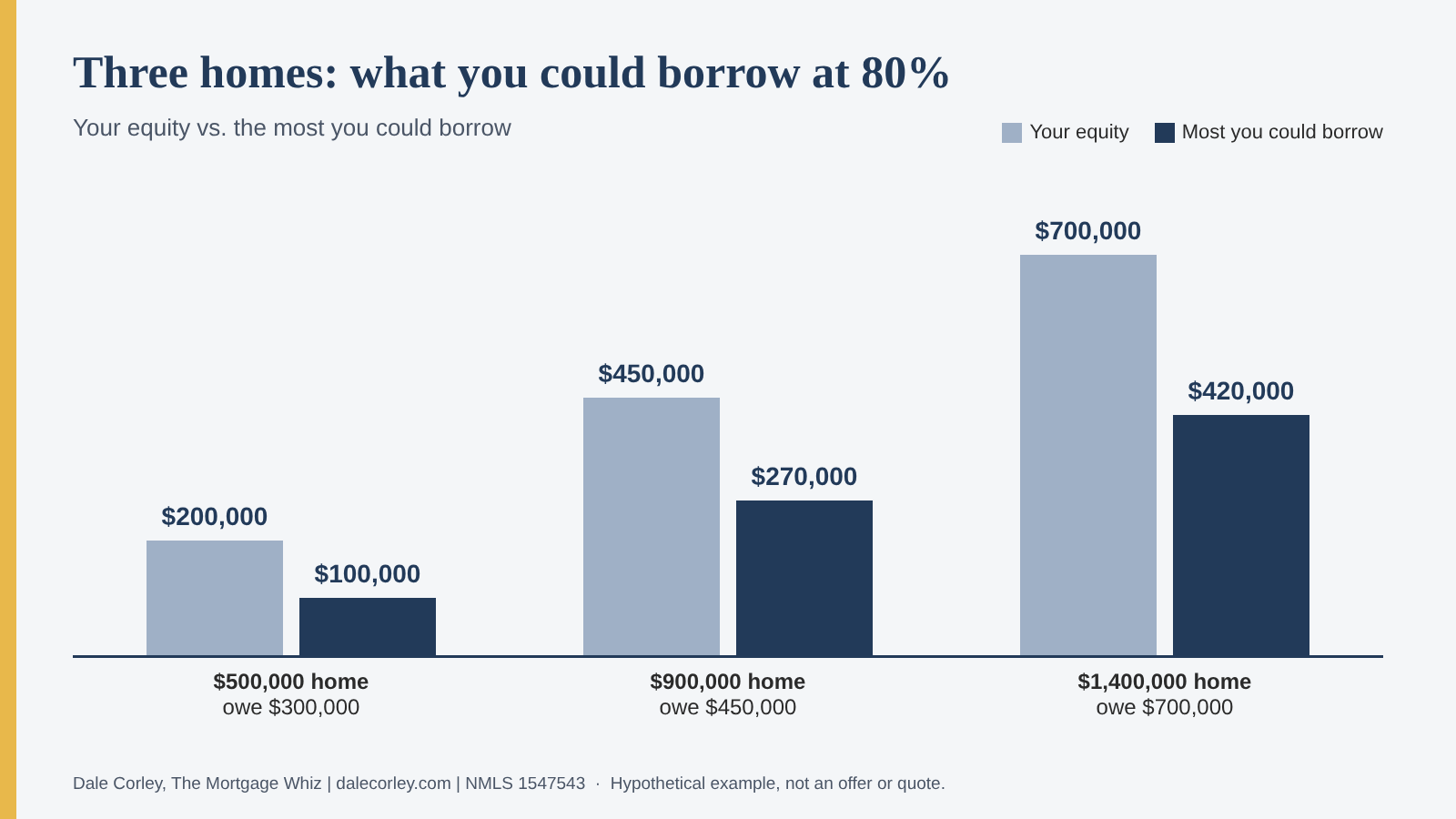 At 80% of value, these three owners could borrow $100,000, $270,000 and $420,000.
Why does the lender stop at 80%, and can it go higher?
Lenders leave 20% of the home’s value as a cushion in case prices drop. For a cash-out refinance, Fannie Mae and Freddie Mac set that line. They make the rules for most conventional loans, and both cap a cash-out refinance on a one-unit home you live in at 80% of value. The limit also depends on the property. Freddie Mac’s limits match these from Fannie Mae:
| Property | Cash-out refinance limit, as a share of value |
|---|---|
| One-unit home you live in | 80% |
| Two- to four-unit home you live in | 75% |
| Second home | 75% |
| One-unit rental | 75% |
| Two- to four-unit rental | 70% |
Eligible veterans can go higher: on most VA programs I use, a VA cash-out refinance goes up to 90% of value. FHA stops at 80% (HUD, 2019). Jumbo and non-QM (non-traditional) loans set their own limits, and I don’t cover them here.
Credit lines and home equity loans follow each lender’s own limits. Some go higher than 80% on a home you live in, mainly lines of $400,000 or less. My HELOC page shows the limits on the programs I use today.
Texas is the exception. State law caps a cash-out refinance, home equity loan or HELOC on the home you live in at 80% of value, counting the first mortgage, even on a VA loan. It doesn’t allow a home equity loan or HELOC on a rental or second home.
What can shrink my number?
Four things can make the real number smaller than the two-step math:
- The appraisal. The lender uses an appraisal (an independent estimate of what the home would sell for) or, for some smaller credit lines, a computer valuation. It uses today’s value, not what the home will be worth after a remodel. If the appraisal comes in $50,000 lower than your guess, you can borrow $40,000 less (80% of $50,000).
- Closing costs on a cash-out refinance. They usually run about 1.5% to 2.5% of the new loan and come out of your cash. On the $500,000 home, an 80% cash-out loan of $400,000 has about $6,000 to $10,000 in costs, so you’d walk away with about $90,000 to $94,000.
- How long you’ve had your mortgage. A conventional cash-out refinance usually needs your current mortgage to be at least 12 months old and your name on the home’s title (the legal record of who owns it) for at least 6 months.
- Your income. The new payment has to fit. Lenders check your debt-to-income ratio, which is your monthly debts compared with your monthly income before taxes. If the bigger payment pushes it past the lender’s limit, you’ll be approved for less.
What would the payment be?
On $100,000, the payment is about $573 a month interest only, or $768 a month paid off over 20 years. These use my 6.875% example rate for a HELOC, home equity loan or cash-out refinance alike. In my experience, second mortgages and credit lines often price above a first mortgage, so your real rate may be higher.
| Amount you borrow | Interest only (HELOC draw period) | Paid off over 20 years | Paid off over 30 years |
|---|---|---|---|
| $50,000 | $286 | $384 | $328 |
| $100,000 | $573 | $768 | $657 |
| $250,000 | $1,432 | $1,920 | $1,642 |
Most HELOCs let you pay interest only while you draw, often for 5 to 10 years. After that, the payment goes up because you start paying the balance down. A home equity loan pays it down from day one.
The longer payoff is cheaper each month but costs more overall. On $100,000, 20 years of payments adds up to about $84,000 in interest, and 30 years about $136,000. You can pay extra any month to shorten it.
Paying off credit cards is where the payment math is clearest. I worked a full example in my Home Equity Playbook.
Can I borrow against a rental property?
Yes, but the limit is lower. For a cash-out refinance, Fannie Mae and Freddie Mac stop at 75% of value on a one-unit rental and 70% on two to four units.
Here’s an example. A one-unit rental worth $600,000 with $250,000 owed:
- 75% of $600,000 is $450,000.
- Minus the $250,000 owed, you could borrow about $200,000.
- If it were a fourplex worth the same, 70% gets you about $170,000.
Fewer lenders offer credit lines on rentals (none in Texas), and the limit is lower than on a home you live in. A common move I see is drawing on one rental’s equity for the down payment on the next one. My HELOC page has a worked example of an investor doing that with a paid-off rental.
Whiz Advice
- Size the project to today’s value, and plan the budget around what the home is worth now.
- If your number is tight, ask me to check the value before you sign a contractor. A low appraisal after you’ve committed to the project is the surprise I most want to avoid.
- If you’re close to 760 and need more than $400,000, raise your score before you apply, not after.
- Leave yourself a cushion beyond the lender’s. Values can dip. The extra equity gives you room to sell or refinance later without bringing cash to the table.
Why use a mortgage broker?
I shop your rates with other lenders, so you don’t have to.
Shopping for a mortgage on your own means applying again and again, sending the same documents over and over, and waiting on every quote. I do that part for you, with one application.
What you get when you work with me:
- One application, one credit pull. I compare hundreds of lenders for you, including most of the big banks and big lenders.
- More loan options than one bank can offer. VA, jumbo, bank statement, DSCR and other non-QM (non-traditional) loans. A single bank can only offer its own programs.
- Pricing from a large wholesale platform. I’m a mortgage broker with NEXA Lending, the largest brokerage in the country by loan officer headcount. In my experience, that volume helps me get wholesale pricing that many banks can’t match.
- Help when your file isn’t standard. If you’re self-employed, have unusual income or have a lower credit score, I know which lenders fit.
- A real person from start to finish. I answer your questions and make sure your application is accurate, so there are no surprises later.
What should I do this week to get my number?
- Pull your latest mortgage statement and write down your balance. Add any other loan on the home.
- Get a realistic value. An online estimate is a starting point. Look at two or three recent sales of homes like yours nearby, or ask me to pull them.
- Run the two steps under “How do I work out my own number?” with your own numbers, or use the how-much-cash calculator on my cash-out refinance page.
- Get your credit cards low, ideally under 10% of your limits and no higher than 30%, so your score is as strong as it can be when you apply.
- Send me your numbers. My job is to help you find the loan program that fits best and make sure your application is accurate.
Pick your next step:
- Ready to get pre-approved or refinance? Start your loan application. It’s the fastest way to see your real number.
- Have a one-of-a-kind situation? Book a 15-minute call and we’ll talk it through.
- Just have a question? Email me at [email protected] with your scenario, and I’ll write back.
I’m a mortgage broker with NEXA Lending, and I work with borrowers in all nine states where I’m licensed (CA, CO, TX, FL, GA, NC, SC, TN, VA). Programs, rates and approval depend on your full file.
Last reviewed November 11, 2026
Sources: HousingWire, ICE Mortgage Monitor home equity data, Nov 9, 2026, Fannie Mae Eligibility Matrix, Apr 1, 2026, Freddie Mac, maximum LTV/TLTV/HTLTV ratio requirements, Fannie Mae Selling Guide B2-1.3-03, cash-out refinance transactions, HUD Mortgagee Letter 2019-11, FHA cash-out refinance, FHFA, 2026 conforming loan limits, Texas A&M Real Estate Research Center, home equity loans in Texas, CFPB, what is a home equity line of credit.
Dale Corley | NMLS #1547543 | Licensed in CA, CO, TX, FL, GA, NC, SC, TN, VA | This is not a commitment to lend.