
Mortgage Tips
Should You Wait for Mortgage Rates to Drop? How to Buy Now and Refinance Later
Dale Corley · · 8 min read
In early November 2026, mortgage rates slipped for the third week in a row, and the call I keep getting this month sounds the same every time: should we wait for mortgage rates to drop before we buy?
Here’s how I answer that across my desk, with the math to back it up. I’m a mortgage broker, so I shop your loan across hundreds of lenders and you don’t have to. If you’re on the fence right now, send me your numbers and I’ll run both paths for you: buying now, and waiting.
Key takeaways
- Buy when the home and the payment fit at today’s rate. A refinance later is a bonus, not the plan.
- On a $600,000 30-year fixed loan, going from my 6.875% example rate to 6.375% saves about $198 a month.
- A seller credit can pay for a buydown that cuts your payment in year one, without waiting on the market.
- On my $9,000 refinance example, a half point drop takes about 45 months to pay back, and a full point about 23.
- I shop hundreds of lenders so you don’t have to.
On this page: Should I wait? · What rates did this month · What a lower rate saves · Refinance later · Lower your payment today · If rates stay put · Whiz Advice
Should I wait for mortgage rates to drop?
Not if the home and the payment already work for you. Waiting is a bet that rates will fall, and nobody, me included, can call that ahead of time. Meanwhile you keep paying rent or carrying your current home, and the house you like may sell to someone else.
I’d rather you buy on a plan that works at today’s rate and gets better if rates fall. That’s the “buy now, refinance later” plan, and below I’ll show you exactly what it does and doesn’t do.
There’s another reason I don’t tell buyers to sit out right now: buyers have the upper hand. In Redfin’s November 5, 2026 report, 21.2% of homes for sale had a price cut in the four weeks ending November 1. That gives you room to ask the seller for help with your costs. I explain how to use that in my post on buyers’ negotiating power right now.
What happened to mortgage rates this month, and what do forecasters expect?
Freddie Mac’s weekly average for the 30-year fixed was 7.18% on November 5, 2026, down from 7.24% the week before. They fell because bond yields fell. The 10-year Treasury yield, which mortgage rates tend to follow, fell to 4.84% on November 5, 2026, its lowest level since early September, according to Mortgage Professional America. Mortgage News Daily tied the drop to losses in tech stocks, which pulled bond yields down, and warned that a stock rebound would likely push rates back up. On November 10, Mortgage News Daily’s daily index had the 30-year fixed at 7.30%. That’s a different survey than Freddie Mac’s, but it’s a reminder of why I don’t plan around one good week.
Forecasters aren’t promising much relief. Zillow expects mortgage rates to stay above 7% for the rest of 2026 and through mid-2027, as Mortgage Professional America reported on November 5, 2026.
What does a lower mortgage rate save me each month?
On a $600,000 30-year fixed loan, a rate half a point lower than my 6.875% example saves about $198 a month, and a full point lower saves about $392. These are examples, not quotes: a 30-year fixed conventional loan, principal and interest only (the loan payment before taxes and insurance), with 6.875% as my example starting rate so my posts stay comparable.
| Loan amount | Payment at 6.875% | At 6.375% | You save | At 5.875% | You save |
|---|---|---|---|---|---|
| $400,000 | $2,628 | $2,495 | $132 a month | $2,366 | $262 a month |
| $600,000 | $3,942 | $3,743 | $198 a month | $3,549 | $392 a month |
Savings use unrounded payments.
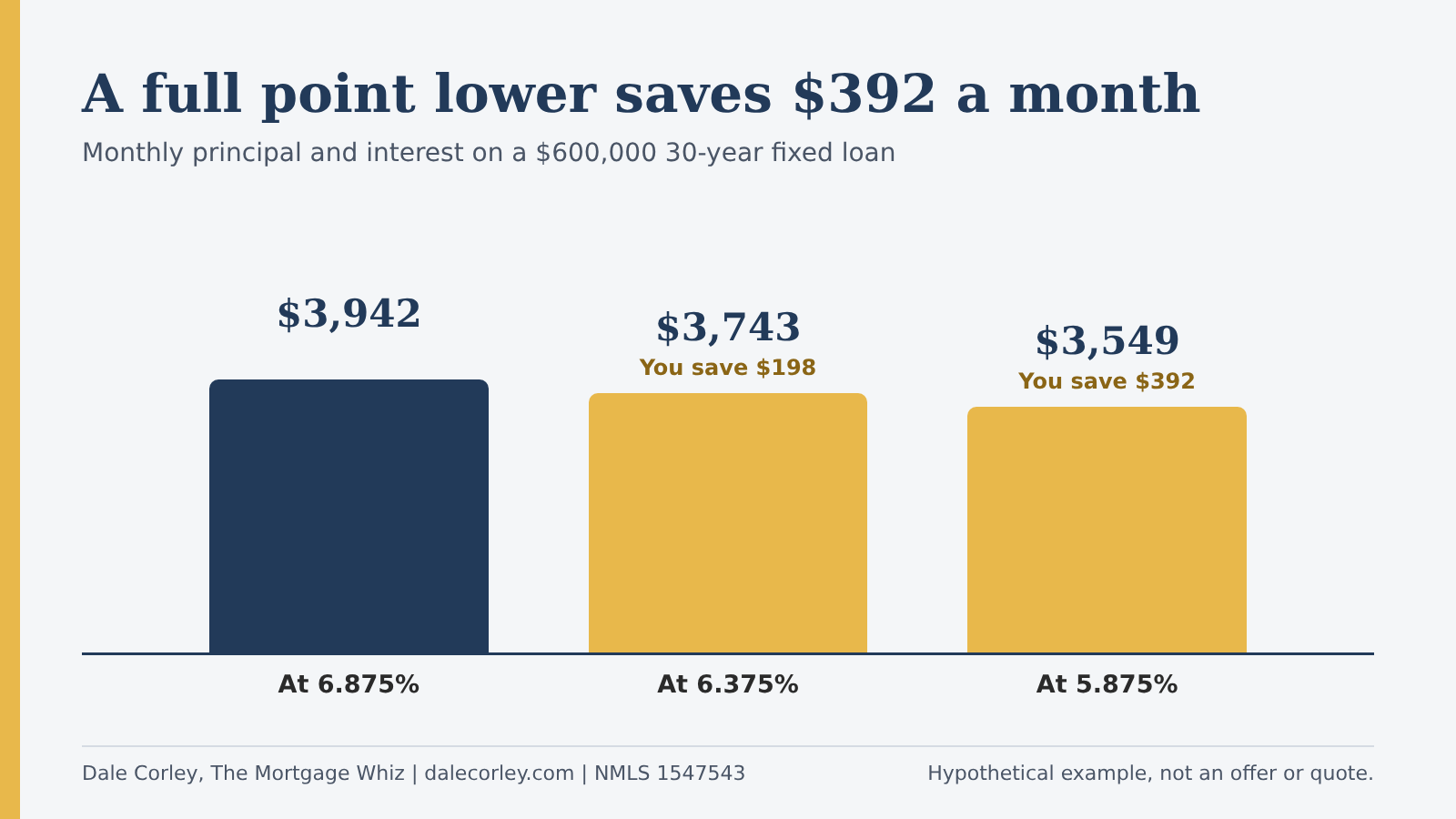 A full point lower saves $392 a month on a $600,000 loan.
Can I buy a house now and refinance later?
Yes. A refinance replaces your mortgage with a new one at a lower rate. You buy the house you want now, and if rates fall enough later, you refinance and lower your payment. A refinance means qualifying again, with your income, credit and a new appraisal, so I make sure your payment works even if you never refinance.
A refinance has closing costs, so it only pays once the monthly savings cover them. Here’s the simple test I run for clients: divide the refinance costs by the monthly savings. That tells you how many months it takes to come out ahead.
Say a refinance on the $600,000 loan costs $9,000. That’s an example; I’d quote your real number.
- If you can refinance half a point lower (6.375% on my example), you save roughly $198 a month, so it takes about 45 months to come out ahead.
- If you can refinance a full point lower (5.875%), you save roughly $392 a month, so it takes about 23 months.
A refinance also restarts your 30-year clock, so I compare total cost too, not just the payment.
If you plan to stay well past that point, the refinance usually makes sense. If you might move sooner, a small drop may not be.
How do a seller credit and a rate buydown lower my payment today?
You don’t have to wait on the market to get a lower payment. A seller credit is money the seller agrees to pay toward your costs at closing, and you can use it for a rate buydown. A buydown lowers your interest rate, either for the first year or two (a temporary buydown) or for the whole loan (discount points, where one point costs 1% of the loan).
Here’s an example: an $800,000 home with 25% down, so a $600,000 loan. A 1-0 buydown lowers the rate by one point for the first year, from my 6.875% example rate to 5.875%. That saves $392 a month for 12 months, and it costs about $4,708, which the seller can pay as a credit. With 25% down on a home you’ll live in, Fannie Mae (the company that sets the rules for most conventional loans) lets the seller pay up to 9% of the price, or $72,000 here. The buydown money counts toward that limit, and a credit can’t be more than your actual costs.
I ask for the credit first and a price cut second, because on the examples in my other posts, a credit comes out ahead of a same-size price cut for about 12 to 13 years. My seller credits playbook shows how to ask for one and the limits for each loan type.
What if mortgage rates don’t drop for a year?
Then you’re still in the home, at a payment you chose on purpose. On the $600,000 example at 6.875%, your first year of payments also pays down about $6,243 of the loan.
If you’d rather start with a lower rate on day one, an adjustable-rate mortgage can do that. Mortgage News Daily’s index put the 7/6 adjustable rate (locked for 7 years, then it can change every 6 months) at 6.80% on November 10, 2026, against 7.30% for the 30-year fixed. An ARM is one of the first things I run for buyers who expect to sell or refinance within the lock period, which can be 5, 7 or 10 years. I compare it with the fixed loan in my post on whether an adjustable-rate mortgage is a good idea right now.
Whiz Advice
- Count the seller credit before the refinance. The credit is money you get at closing. The refinance only helps if rates fall far enough to pass your breakeven.
- Name the buydown in the offer. Write the dollar amount, for example “$4,708 toward a 1-0 buydown”, using the exact cost I give you for your loan, so the seller and the lender read it the same way.
- Lock your rate once your offer is accepted, not when you guess the bottom. A rate lock is the lender’s promise to hold your rate for a set number of days while the loan closes.
- Ask me to rerun the refinance math whenever rates move. I’ll use your real costs, not a rule of thumb.
Why use a mortgage broker?
I shop your rates with other lenders, so you don’t have to.
Shopping for a mortgage on your own means applying again and again, sending the same documents over and over, and waiting on every quote. I do that part for you, with one application.
What you get when you work with me:
- One application, one credit pull. I compare hundreds of lenders for you, including most of the big banks and big lenders.
- More loan options than one bank can offer. VA, jumbo, bank statement, DSCR and other non-QM (non-traditional) loans. A single bank can only offer its own programs.
- Pricing from a large wholesale platform. I’m a mortgage broker with NEXA Lending, the largest brokerage in the country by loan officer headcount. In my experience, that volume helps me get wholesale pricing that many banks can’t match.
- Help when your file isn’t standard. If you’re self-employed, have unusual income or have a lower credit score, I know which lenders fit.
- A real person from start to finish. I answer your questions and make sure your application is accurate, so there are no surprises later.
What should I do this week if I’m thinking about buying?
Here’s what you can do this week:
- Get pre-approved before you shop. You’ll know your top price, and your offer looks stronger to the seller.
- Get your credit cards low, ideally under 10% of your limits and no higher than 30%, so your credit score is as strong as it can be when you apply. How much of your limits you’re using is one of the quickest parts of your score to improve.
- Set your top monthly payment, including property taxes, insurance and any HOA dues, and shop by that number.
- Send me your numbers. My job is to help you find the loan program that fits best and make sure your application is accurate.
Pick your next step:
- Ready to get pre-approved? Start your loan application. It’s the fastest way to find out what you can buy.
- Have a one-of-a-kind situation? Book a 15-minute call and we’ll talk it through.
- Just have a question? Email me at [email protected] with your scenario, and I’ll write back.
I’m a mortgage broker with NEXA Lending, and I work with borrowers in all nine states where I’m licensed (CA, CO, TX, FL, GA, NC, SC, TN, VA). Programs, rates and approval depend on your full file.
Sources: Freddie Mac Primary Mortgage Market Survey (Nov 5, 2026), Mortgage Professional America, Nov 5, 2026, Mortgage News Daily, Nov 5, 2026, Mortgage News Daily rate index, Nov 10, 2026, Redfin housing market update, Nov 5, 2026, Fannie Mae Selling Guide B3-4.1-02, interested party contributions, National Mortgage Professional, NEXA Lending Signals The End Of “Brokers Are Better”, Oct 2, 2025.
Dale Corley | NMLS #1547543 | Licensed in CA, CO, TX, FL, GA, NC, SC, TN, VA | This is not a commitment to lend.