
Mortgage Tips
Are Adjustable-Rate Mortgages a Good Idea Right Now? Here's the Math
Dale Corley · · 8 min read
Average rates are sitting around 7.4%, and a lot of people are saying the market has stalled. I’m not seeing that. Buyers with strong files can still get a rate in the 6s, and an adjustable-rate mortgage is my go-to loan right now.
An adjustable-rate mortgage, or ARM, is a home loan where the rate is locked for the first 5, 7 or 10 years, depending on the loan, and can change after that. Because it starts lower, ARMs hit 14% of mortgage rate locks in September 2026, the highest share since Optimal Blue’s data began in 2019.
The only buyers I’d steer toward a 30-year fixed are the ones who are sure they’ll stay in the home for good and never refinance. Even then, I run both side by side. The trade-off is simple. The low rate is locked for a set number of years, usually 5, 7 or 10, and you plan to sell or refinance before it can move. In those years the savings are big. This post shows exactly how big, and what happens if you stay longer.
Key takeaways
- Average fixed rates are around 7.4%. For a strong borrower, an ARM can still start lower than a fixed loan. In the example below, you save about $291 a month, or $3,492 a year.
- The rate is locked for 5, 7 or 10 years depending on the loan, then it can adjust.
- Even if the rate went up after year 5, the example stays ahead for years. The charts below show it.
- ARMs fit best if you expect to sell or refinance before the fixed period ends.
- The Edge: don’t pick an ARM because someone says rates will drop. Pick one that wins even if they never do.
Is an adjustable-rate mortgage a good idea right now?
For a lot of buyers, yes. Rates jumped fast. The average 30-year fixed rose 67 basis points in September alone, and the Mortgage Bankers Association’s chief economist expects it to hover around 7.3% through year-end and stay above 7% through 2027. I wouldn’t build a plan that only works if rates fall.
On October 19, Mortgage News Daily had the average 30-year fixed at 7.43% and the average 7/6 ARM at 6.81%. A strong borrower prices better than the averages. Here’s a scenario I priced this week for a borrower with this profile. It’s an example, not a quote.
A $990,000 home, $400,000 down, a $590,000 loan, a 780 credit score and 60% loan to value. Same borrower, two loans: a 30-year fixed at 6.875% (about 6.97% APR) and a 5-year ARM at 6.125% (about 6.59% APR).
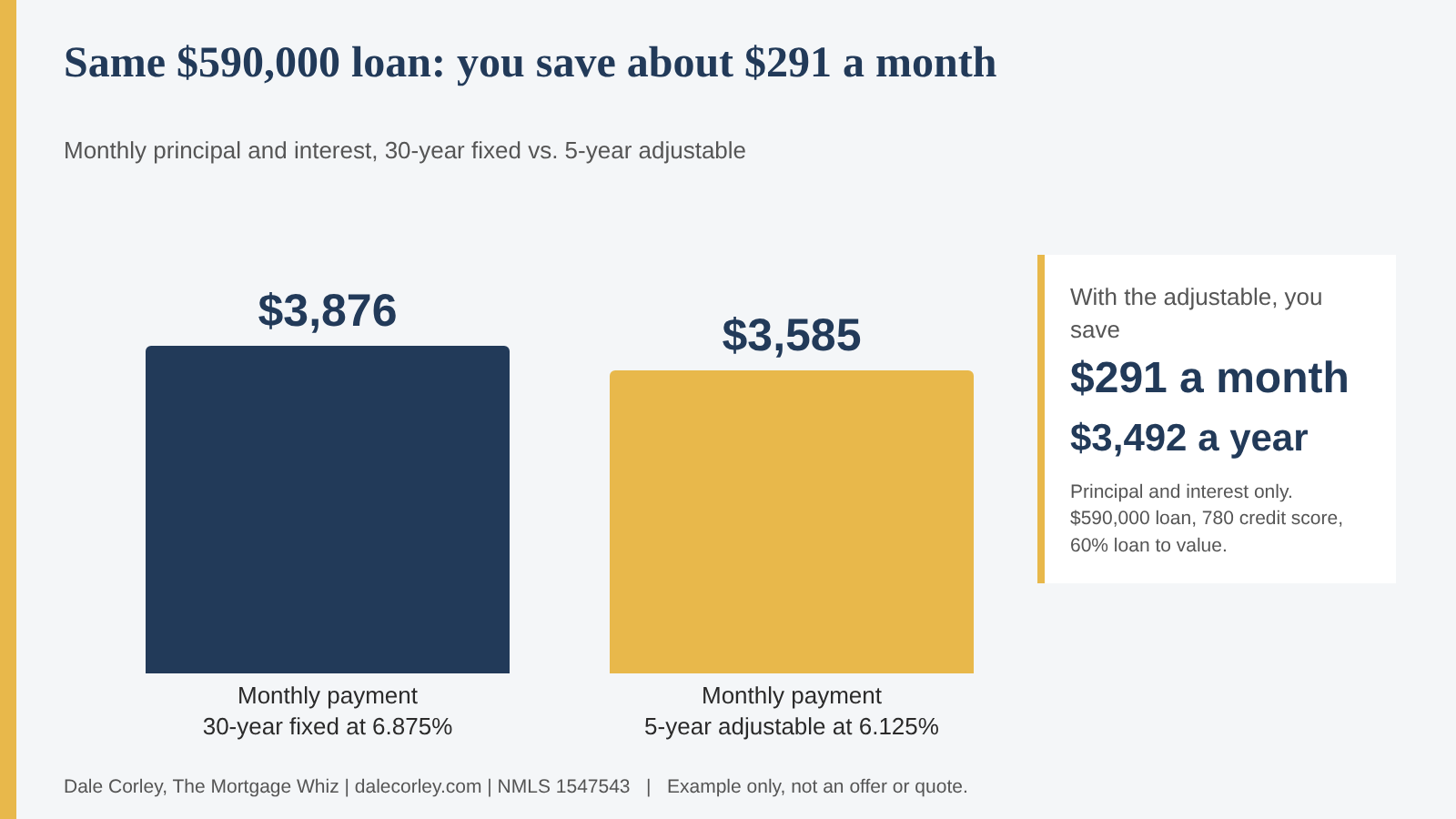
Caption: principal and interest only. Taxes and insurance are the same either way. Example only, not a quote.
You save $291 a month, and you also pay the loan down faster. After 5 years you’d owe about $4,800 less on the lower rate.
Why are adjustable rates lower than fixed rates right now?
An adjustable loan is priced like a short loan, and a 30-year fixed is priced like a long one. Lenders and investors want more for tying up their money longer, and right now long-term rates are higher than short-term ones. On October 9, the 10-year Treasury yield was 5.24% and the 2-year was 4.80%. That gap is a big part of why a 5-year or 7-year adjustable loan starts lower than a 30-year fixed today.
It isn’t always this way. In my career, there have been stretches when adjustable loans made more sense and stretches when they didn’t. When short-term rates catch up to long-term rates, the adjustable advantage shrinks. Right now, it’s a good stretch.
What is an adjustable-rate mortgage?
It’s a home loan with a rate that stays the same for a set number of years, then adjusts. During the fixed period your payment doesn’t move. After it, the rate is reset to a market benchmark called an index (these days, usually SOFR) plus a margin your lender sets at closing.
Caps put a ceiling on the change. One cap limits the first adjustment, another limits each later one, and a lifetime cap limits the total. The cap numbers are written in your loan documents, and I walk through them with you before you sign.
What do the numbers in 5/6, 7/6 and 10/6 mean?
The first number is how many years the rate is locked. The second is how often the rate can change after that. A “6” means every six months. A “1” means once a year. So a 5/6 ARM is locked for 5 years, then adjusts every 6 months.
| Loan | Rate locked for | Then it adjusts | Where it fits |
|---|---|---|---|
| 3/6 | 3 years | Every 6 months | A short plan. The least time for life to change. |
| 5/6 | 5 years | Every 6 months | The one I run most often. Great if you expect to sell or refinance in about 5 years. |
| 7/6 | 7 years | Every 6 months | More breathing room. Qualifying is easier, see The Edge. |
| 10/6 | 10 years | Every 6 months | The longest window to plan around. |
| 5/1, 7/1, 10/1 | 5, 7 or 10 years | Once a year | The older naming. Same idea, but it adjusts yearly. |
| 1/6 and 6-month ARMs | 1 year or less | Every 6 months | Rate sheets list them. They adjust almost right away, so I steer clear. |
| Interest-only ARM | Varies | Varies | You pay only interest for a period, so the balance doesn’t go down. Some lenders offer it. Ask me before you consider one. |
Most conventional adjustable loans today are the 6-month kind (5/6, 7/6, 10/6) because the market moved to SOFR.
How much will you save, and what happens when the fixed period ends?
Here’s what you save in total, depending on how long you keep the loan. After year 5, the chart shows two paths: the rate stays at 6.125%, or it goes up 2 points. Those are my assumptions for the example, since nobody knows where rates will be.
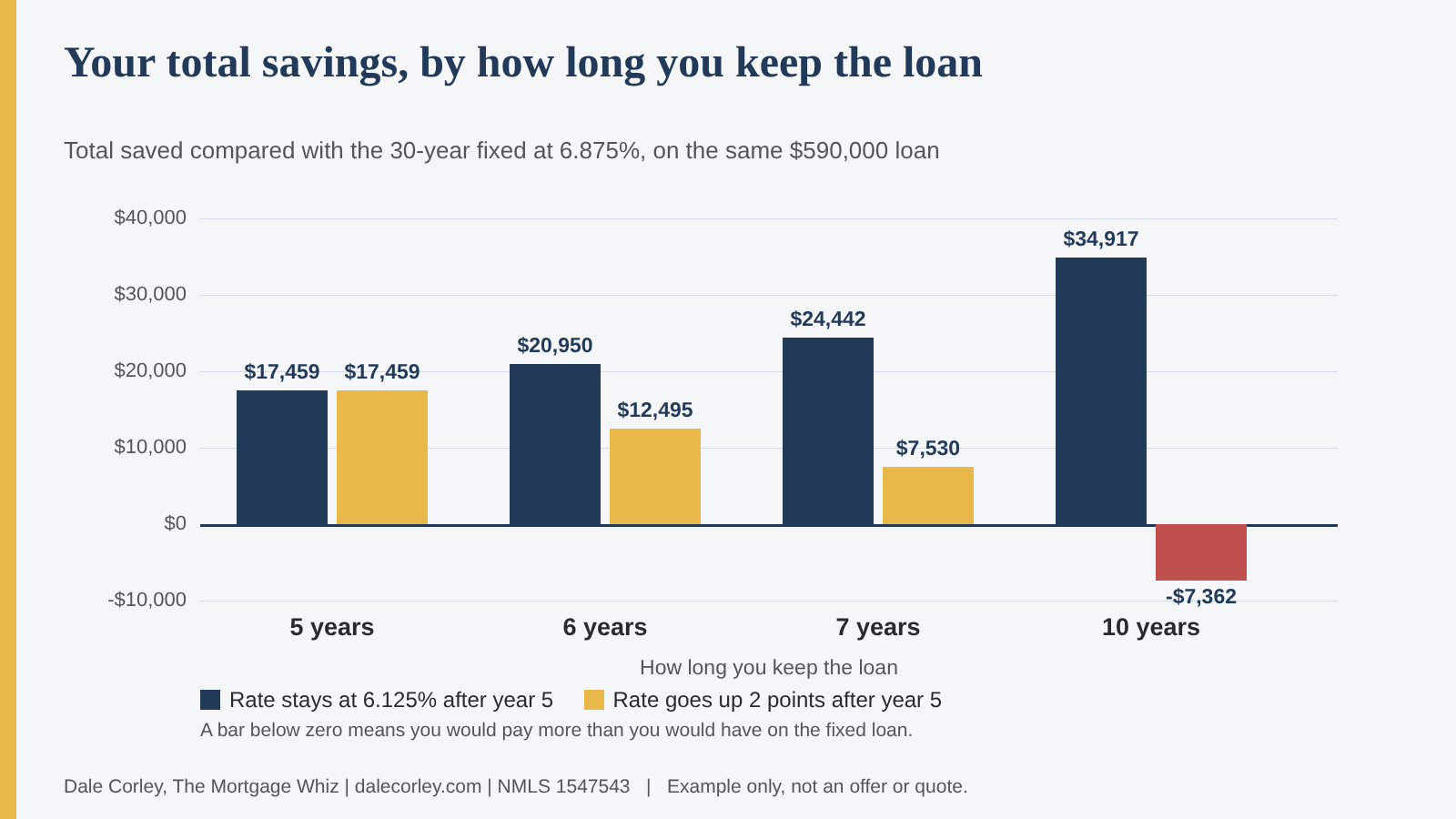
Caption: total payment savings compared with the 30-year fixed at 6.875%. Example only, not a quote.
| If you keep the loan | Rate stays 6.125% | Rate goes up 1 point | Rate goes up 2 points |
|---|---|---|---|
| 5 years | save about $17,500 | save about $17,500 | save about $17,500 |
| 6 years | save about $21,000 | save about $16,800 | save about $12,500 |
| 7 years | save about $24,400 | save about $16,200 | save about $7,500 |
| 10 years | save about $34,900 | save about $14,200 | pay about $7,400 more |
Here’s the worst case, so nothing surprises you. If the rate went up 2 points at year 5, your payment would go from $3,585 to about $4,290, compared with $3,876 on the fixed loan. If it went up 1 point, it would be about $3,930. Even then, you’d come out ahead for years. In a harsh path where the rate climbs 2 points at the first adjustment and 1 point every six months after that, up to 5 points above the start (the typical 2/1/5 cap setup, and yours may differ), the savings run out around year 7.
If rates are lower by year 5, you can refinance and keep saving. If they aren’t, you’ve already saved about $17,500 and you know the worst case up front.
How do the 5-year, 7-year and 30-year fixed compare?
Here are all three on the same loan, with no points:
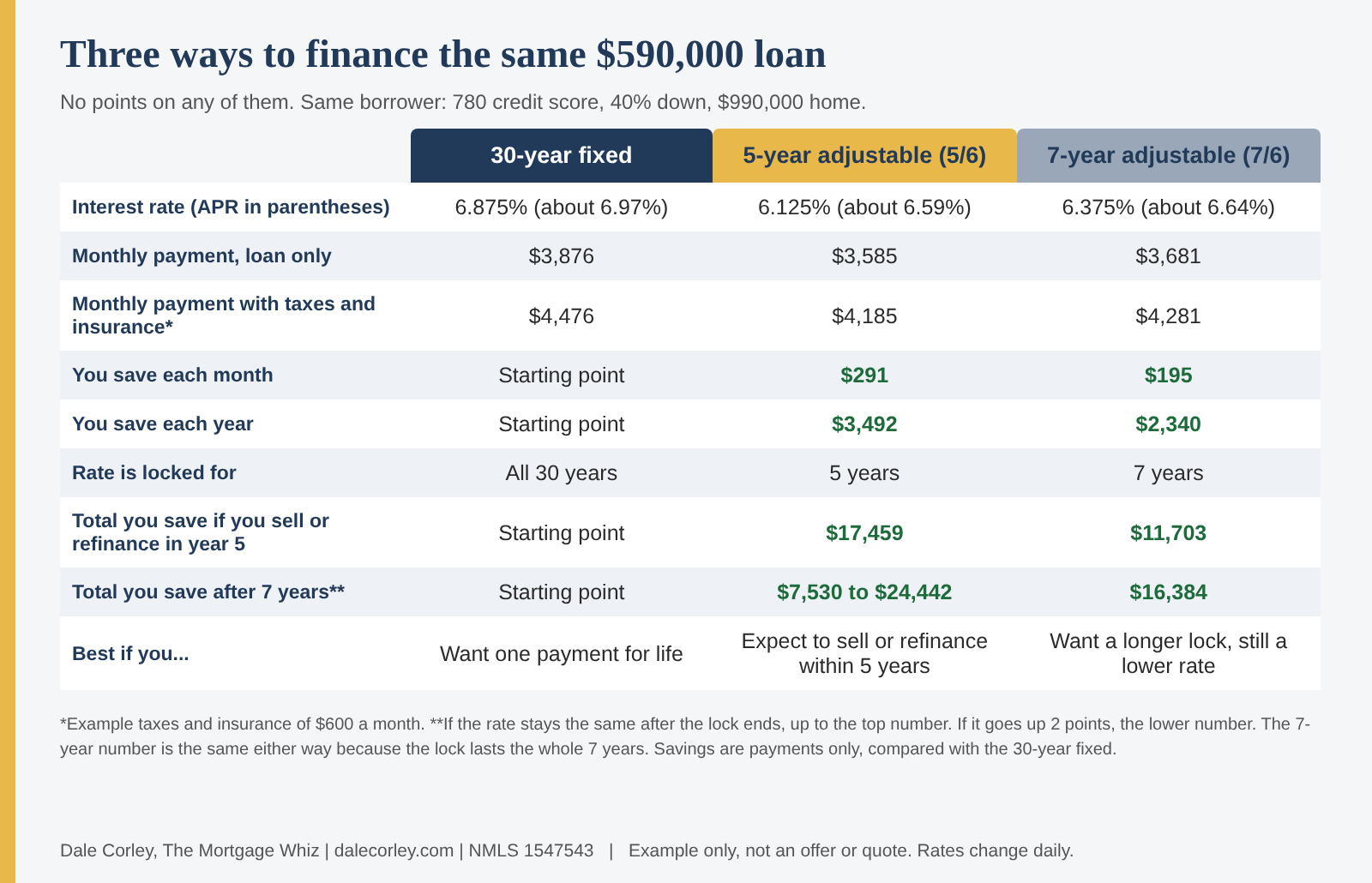
Caption: loan-only payments compared with the 30-year fixed. Example only, not a quote.
The 7-year saves less each month, but the rate is locked longer. It’s the one I point people to when they want more time. Even if the rate went up 2 points after year 7, you’d be about even with the fixed loan at year 10.
Is an adjustable-rate mortgage a good fit for you?
It tends to fit if you:
- expect to sell or move within 5 to 10 years, like a job move, a growing family or a starter home,
- expect your income to grow,
- want the payment to work today without waiting for rates to fall.
It’s a weaker fit if this is your forever home, you’re stretched on budget, or a payment that could change would cost you sleep. Both are fine. Pick on purpose.
One more thing to weigh: homeowners are staying put longer right now. The National Association of Realtors found that sellers had lived in their home a median of 11 years, a record. If that sounds like you, the 7-year or 10-year loan gives you a longer lock.
The Edge: pick an ARM that wins even if rates never drop
For three years, borrowers have been told “take this loan and refinance when rates come down.” Some of the people who heard that are still waiting. I don’t build plans like that. The savings should be the plan, and a refinance later should be a bonus. That’s why I run the worst-case chart before anyone signs: if the numbers work when nothing improves, it’s a good loan.
There’s also a rule most people don’t know about. Fannie Mae qualifies a borrower on a 5-year ARM at a higher rate than the one you pay. The qualifying rate is the higher of the fully indexed rate, or the note rate plus the first adjustment cap. On 7-year and 10-year ARMs, it can be as low as the note rate. That qualifying payment feeds your debt-to-income ratio, the share of your monthly income that goes to debt. So a 5/6 can ask for more income than a 7/6. On a strong file like the one above that rarely matters, but when it does, the 7/6 is the fix.
How do you get ready to use an adjustable rate?
Here’s what I’d do this week:
- Decide how long you’ll keep the loan. That chooses the 5, 7 or 10-year lock.
- Get your credit cards down. Pay them to zero if you can. If not, keep balances low, ideally under 10% of your limits and no higher than 30%, so your debt-to-income ratio stays healthy.
- Get pre-approved before you shop. I know it usually goes the other way: you find the house, then call me. Flip it. I can run the fixed and adjustable payments side by side before you write an offer, and I can usually move faster than a big bank.
- Leave nothing off the application, and tell me your concerns up front. Anything missing shows up in underwriting and slows the loan late.
- Send me your numbers. I’ll show you what each option does for your budget today and in year 7.
My job is to help you find the loan program that fits your situation best, and to make sure your application is 100% accurate. Call me even if you’re not ready to buy. By the end of the call, I want you to understand your options and what each one means for your budget. My conventional loan page covers the basics, and the mortgage calculator lets you try your own numbers.
Why use a mortgage broker?
Let hundreds of lenders compete for your loan. You fill out one application.
Shopping for a mortgage on your own means applying again and again, sending the same documents over and over, and waiting on every quote. I do that part for you.
Here’s how it works:
- Tell me your goals. I review them and structure your loan.
- I shop it. I enter your scenario into my loan search system. It checks hundreds of lenders, including most of the big banks and big lenders, and sorts them by rate, APR (the yearly cost of the loan, including fees), monthly payment or total cost.
- You get the best deal. If the lowest rate is your goal, I sort by rate, find the lender with the lowest rate at the moment you’re ready to lock, and lock it. Typically 350 or more lenders sit underneath with higher rates.
One application. One set of documents. Hundreds of lenders working for your business. I also make sure your application is accurate, so there are no surprises later.
Pick your next step:
- Ready to get pre-approved? Start your loan application. It’s the fastest way to find out what you can buy, or what a refinance could save you.
- Have a one-of-a-kind situation? Book a 15-minute call and we’ll talk it through.
- Just have a question? Email me at [email protected] with your loan scenario or your question, and I’ll write back.
I’m a mortgage broker with NEXA Lending, and I work with borrowers in all nine states where I’m licensed (CA, CO, TX, FL, GA, NC, SC, TN, VA). As a broker, I can shop your loan across hundreds of lenders. Programs, rates and approval depend on your full file, and individual rates vary. This is educational and not tax or legal advice.
Sources: HousingWire on Optimal Blue’s September 2026 report, National Mortgage Professional on the same report, Mortgage Professional America on Optimal Blue’s ARM findings, Advisor Perspectives Treasury yields snapshot, Oct. 9, 2026, Mortgage News Daily rate index, Oct. 19, 2026, Freddie Mac Primary Mortgage Market Survey, CFPB key mortgage terms, Freddie Mac SOFR-indexed ARMs, Fannie Mae Selling Guide B2-1.4-02, NAR press release on its buyer and seller profile, Fannie Mae Selling Guide B3-6-04.
Dale Corley | NMLS #1547543 | Licensed in CA, CO, TX, FL, GA, NC, SC, TN, VA | This is not a commitment to lend.