
Mortgage Tips
Seller Credits: What They Are, How to Ask for One, and the Best Ways to Use It
Dale Corley · · 9 min read
Home prices are high. Mortgage rates are high. Homes are staying on the market longer. When all three happen at once, something has to give. Some sellers take their home off the market. Some lower the price. And many agree to a seller credit.
A seller credit is money the seller pays at closing toward your costs. You can use it for closing costs, for prepaid items like property taxes and insurance, or to lower your interest rate. I’m a mortgage broker, which means I shop your loan across hundreds of lenders so you don’t have to. This guide explains what a seller credit is, how to ask for one in five steps, how it compares to a price cut, and the pros and cons.
Key takeaways
- A seller credit is money the seller pays at closing toward your costs. You can use it to lower your rate.
- Sellers are giving credits in close to half of home sales, according to Redfin data.
- A strong offer is the full asking price plus a request for a seller credit.
- A $10,000 credit puts more money in your pocket than a $10,000 price cut for about 12 to 13 years.
- The most a seller can pay depends on your loan type and your down payment.
- As a mortgage broker, I shop your loan across hundreds of lenders, so you don’t have to shop your rate yourself.
On this page: What a seller credit is · Why they are common now · How to ask, step by step · Credit vs. price cut · Pros and cons · Limits by loan type · Lowering your rate · Whiz Advice · Why use a broker
What is a seller credit?
A seller credit is an amount the seller agrees to pay toward your costs when the sale closes. It is written into the purchase contract, and it shows up as a credit on your closing statement. The price of the home does not change.
You can use a seller credit for:
- Closing costs, such as lender fees, title fees and appraisal costs.
- Prepaid items, such as the first months of homeowner’s insurance and property taxes.
- A rate buydown, which lowers your interest rate for the first one or two years, or for the whole loan.
You may also hear the terms seller concession and seller contribution. They mean nearly the same thing. A seller concession is anything a seller gives to close the deal, and a seller contribution is money the seller pays toward your costs.
Why are seller credits so common right now?
Sellers want a sale, and buyers want a payment they can live with. A credit helps both. Redfin reported that sellers gave concessions in about 45% of U.S. home sales over the three months covered in its September 2026 report, up from about 43% a year earlier. Redfin also reported that more sellers pulled their homes off the market, with about 5.8% of listings delisted nationwide in April 2026, tied for the highest share since 2020, and Atlanta at 10.7%, the highest of the 50 largest metros.
A seller who has been on the market for weeks may not want to lower the price, because the lower price becomes part of the neighborhood record. A credit lets them keep the price and still make a deal. That gives you room to ask.
How do you ask for a seller credit, step by step?
Here is the process I walk pre-approved buyers through. It has five steps.
- Tell your agent you want to make an offer. Get pre-approved first, so the seller knows your offer is real.
- Decide on the offer. Offer the full asking price and ask for a seller credit up to the limit. With less than 10% down on a conventional loan, the limit is 3%. On an $800,000 home, that is $24,000 toward your closing costs.
- Your agent presents the offer. Your agent takes it to the seller’s agent.
- The seller responds. The seller can agree, say no, or offer something in between.
- You agree, and the negotiation is done. If the seller says no, you can compromise or move on.
One thing to check before step 2: the home has to appraise at the price you agree to. If it appraises for less, the credit gets harder to use. Ask your agent for recent nearby sales before you write the offer.
Is a seller credit better than a price cut?
For the first 12 to 13 years, a credit puts more money in your pocket. Say the seller agrees to $10,000 either way. With a credit, you get the full $10,000 at closing. With a price cut, you save a little every month, and it takes about 12 to 13 years of savings to add up to $10,000. After that, the price cut comes out ahead on paper.
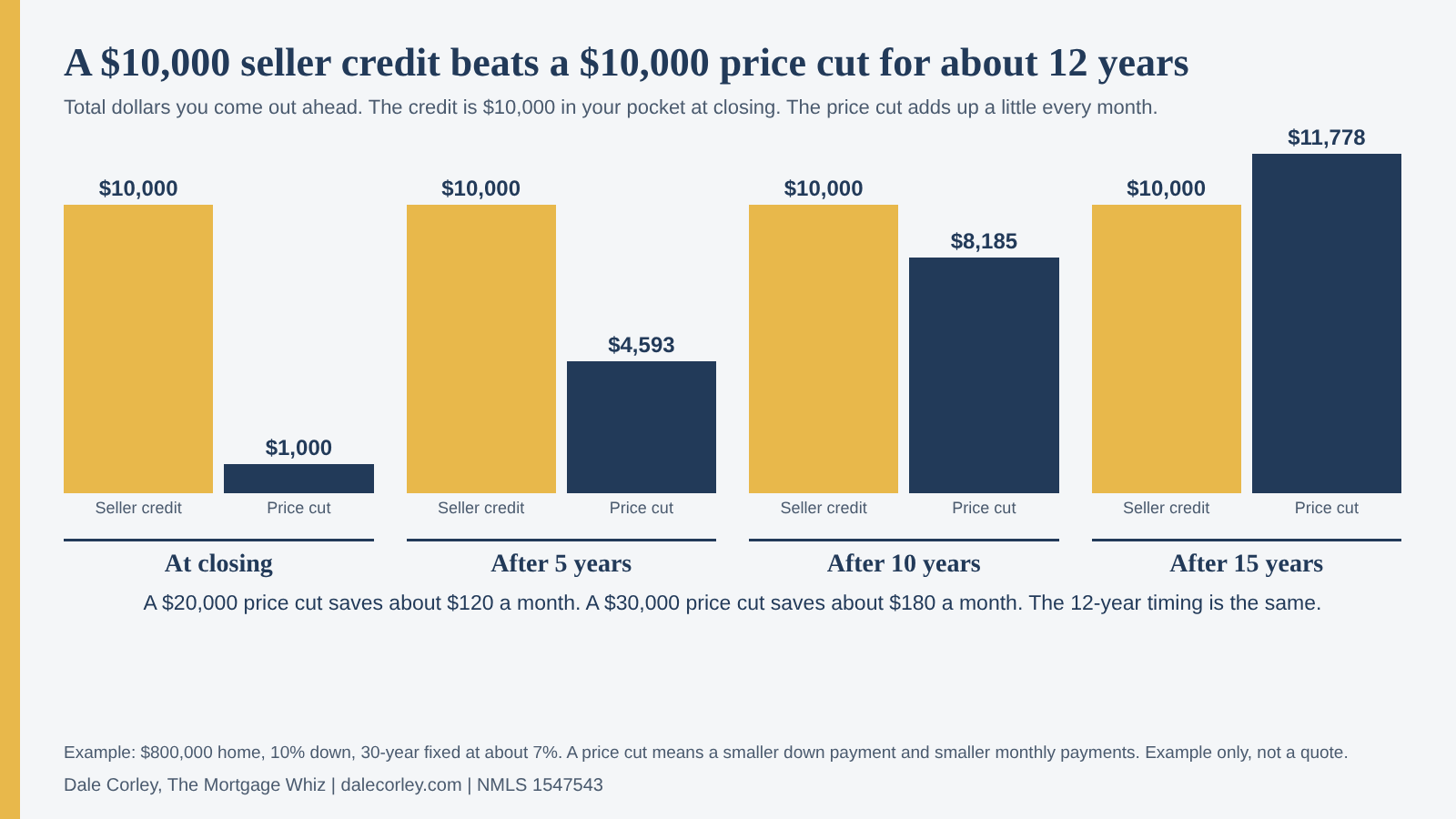
Caption: total dollars you come out ahead. The credit is $10,000 right away. The price cut adds up month by month. A $20,000 price cut saves about $120 a month and a $30,000 price cut saves about $180 a month. The 12- to 13-year timing is the same. The example is an $800,000 home with 10% down on a 30-year fixed loan at about 7%. Example only, not a quote.
A credit also has another advantage: you can use it to lower your rate with a buydown, which a price cut can’t do.
What are the pros and cons of a seller credit?
Pros:
- You get the money at closing. It covers costs you would otherwise pay out of your savings.
- Sellers often say yes. Many sellers will agree to a credit when they won’t lower the price.
- It can lower your rate. A credit can pay for a buydown.
- The price stays on the record. Everyone wins. The seller gets their price, the neighbors’ home values aren’t pulled down, and your new home keeps its value history.
Cons:
- There is a limit. The seller can only pay a set share of the price, and on a conventional loan the credit can’t be more than your actual costs.
- Your loan stays larger. You borrow against the full price. A price cut lowers the payment only a little, about $60 a month for every $10,000 in our example, so the bigger savings come from the closing costs you don’t have to pay up front.
- The appraisal matters. If the home appraises for less than the price, the deal can change.
How much can the seller pay on each loan type?
Every loan program has a limit, and the limit is based on the purchase price. Here are the limits:
| Loan type | Most the seller can pay |
|---|---|
| Conventional (Fannie Mae and Freddie Mac), primary or second home | 3% of the price with under 10% down, 6% with 10% to just under 25% down, 9% with 25% or more down |
| Conventional, investment property | 2% of the price |
| FHA | 6% of the purchase price |
| VA | 4% of the home’s reasonable value in concessions, plus the buyer’s normal closing costs and discount points (no cap on those) |
| USDA | 6% of the purchase price |
| Jumbo | Typically 3% to 6% of the purchase price, set by each lender |
| Non-QM (non-traditional) | Set by each lender |
Fannie Mae and Freddie Mac use the same tiers. They base the limit on the lower of the price or the appraised value. On a VA loan, the funding fee, prepaid items and buydown money count toward the 4%. Closing costs and discount points do not count toward the 4%. On a USDA loan, repair money held in escrow and a seller-paid buyer’s agent commission sit outside the 6%. Jumbo loans have no agency rule, but 3% to 6% of the purchase price is typical. Non-QM (non-traditional) loans are set by each lender. I confirm the number before you write an offer.
How does a seller credit lower your rate?
You can spend a seller credit on closing costs, or you can use it to buy down your rate. There are two kinds of buydowns:
- Temporary buydown (1-0 or 2-1). Your rate is lower for the first one or two years, then it steps up to the full rate. A 1-0 is 1 percentage point lower in year one. A 2-1 is 2 percentage points lower in year one and 1 percentage point lower in year two. My 2-1 buydown page has the basics.
- Permanent buydown (discount points). The seller pays points, and your rate is lower for the whole loan. One point costs 1% of the loan amount, and it typically lowers the rate by about 0.25 percentage point, though that varies by lender and market. On an $800,000 home with 10% down (a $720,000 loan), one point costs $7,200 and lowers the payment by about $120 a month at a 7% rate. Two points cost $14,400 and lower it by about $240 a month. The savings last for the life of the loan, and it takes about five years of savings to pay back the cost of the points. That is an example, not a quote.
Here is what a temporary buydown costs, as a share of the loan amount. A 1-0 buydown costs about 0.8% of the loan. A 2-1 costs about 2.3%, because it lowers the rate twice: about 1.5% of the loan for the 2 percentage points off in year one, plus about 0.8% for the 1 percentage point off in year two.
On an $800,000 conventional purchase, here is how the most a seller can pay stacks up against the cost of each temporary buydown. The numbers below are examples, not quotes.
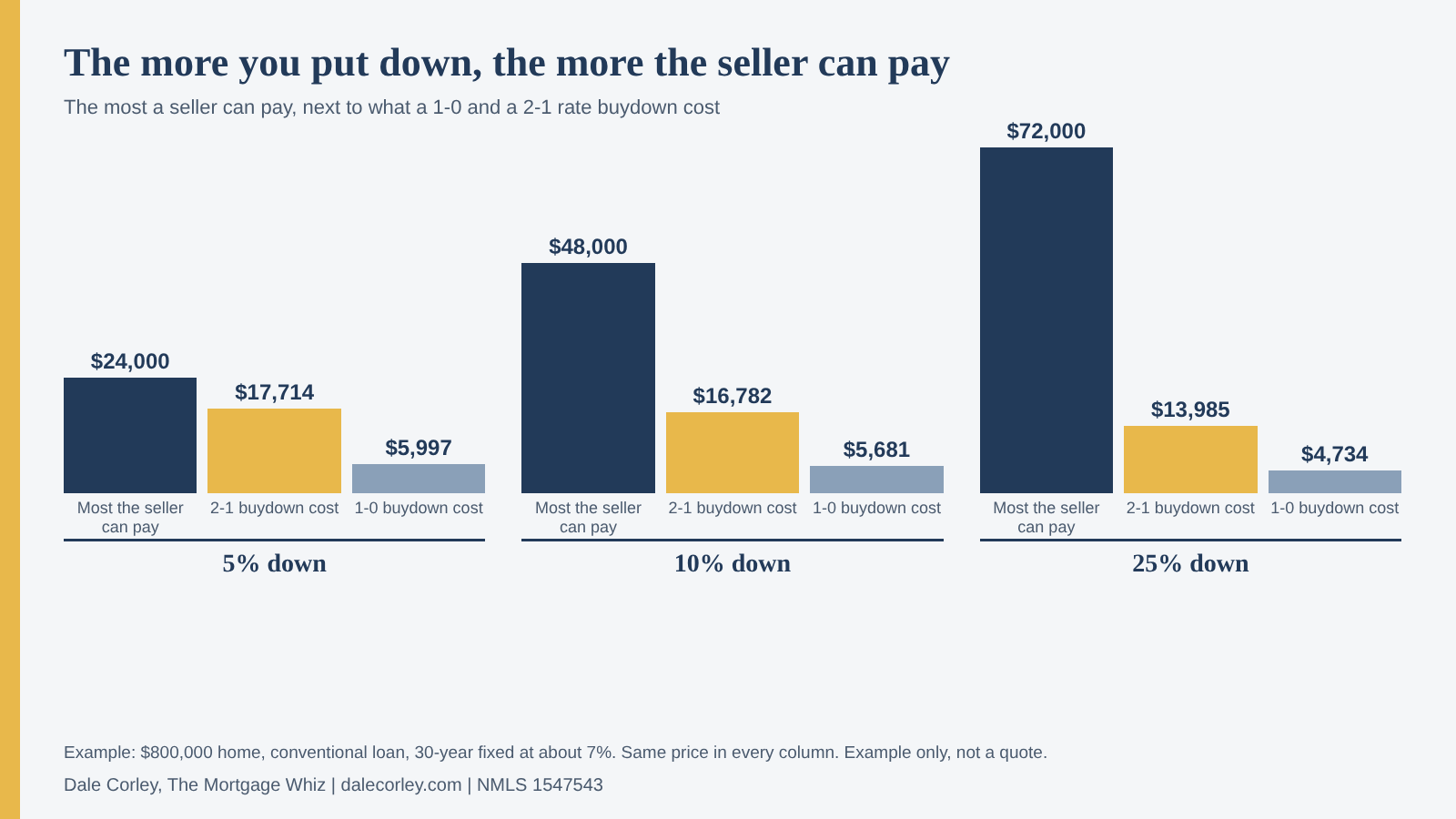
Caption: the most the seller can pay on a conventional loan next to the cost of each buydown. The example is an $800,000 home on a 30-year fixed loan at about 7%, with the same price in every column. Example only, not a quote.
After the buydown period the payment goes to the full-rate payment, so I plan for that payment from day one. If rates are lower by then, a refinance may be an option. I don’t count on it.
Whiz Advice
Here is how I would play it:
- I expect to see more seller credits, and bigger ones. If a home looks overpriced to you, I would go for the full limit in your first offer. The seller can only say no or counter, so asking costs you nothing.
- Ask again after the inspection. If the inspection finds problems, you can ask for a price reduction or for more seller credit, up to your limit.
- Ask for the credit in dollars, not a percent. “$20,000” is clear. Percentages invite an argument about the math.
- Write the credit for costs the lender allows. A credit can only be applied to closing costs, prepaid items and buydown costs, and anything left over can be lost. I tell you the right amount before you write the offer.
- Ask for a credit before a price cut. If the seller says no to a price cut, they may say yes to the same amount as a credit.
- Check the tier before you pick a down payment. The limit goes from 3% to 6% at 10% down. On an $800,000 home, that is a jump from $24,000 to $48,000. If you’re near a tier, ask me before you commit.
- Pay your credit card balances down before you apply. A higher score can get you a lower rate before any buydown. How much of your limit you’re using is one of the quickest parts of your score to improve, and under 10% is the target.
Why use a mortgage broker?
A bank can only offer its own programs. As a broker with NEXA Lending, I’m not stuck with one lender, and I can shop your loan with one application and a soft credit pull option.
I frequently get calls from stressed-out borrowers and their real estate agents looking for urgent help. The closing date is coming fast, and they have just learned from their bank or lender that their loan has been denied. Imagine that added stress and anxiety on top of the already exhausting process of selling, buying and securing financing for a new home.
During our first conversation, I’ll review your two most recent years of tax returns to calculate your maximum qualifying loan amount. If that amount doesn’t get you where you want to be, we’ll talk about a non-traditional loan program that could be a better match to get you the property you want.
Many of the issues that come up in underwriting are guidelines, not a hard stop. If your loan runs into payment shock, thin credit history, or even less than two years of self-employment, an experienced loan officer can often get an underwriting exception using compensating factors.
Qualifying for the loan can be easy. Finding a loan officer with the experience to handle all the nuances is the hard part.
My conventional loan page covers the basics, and the mortgage calculator lets you try your own numbers.
Pick your next step:
- Ready to get pre-approved? Start your loan application. It’s the fastest way to find out what you can buy.
- Have a one-of-a-kind situation? Book a 15-minute call and we’ll talk it through.
- Just have a question? Email me at [email protected] with your scenario, and I’ll write back.
I’m a mortgage broker with NEXA Lending, and I work with borrowers in all nine states where I’m licensed (CA, CO, TX, FL, GA, NC, SC, TN, VA). As a broker, I can shop your loan across hundreds of lenders. Programs, rates and approval depend on your full file. This is educational and not tax or legal advice.
Last reviewed November 16, 2026
Sources: Redfin data reported by Inman, Redfin data reported by Mortgage Professional America, Redfin Data Center, Redfin, delistings, Jun 3, 2026, Fannie Mae Selling Guide B3-4.1-02, Freddie Mac Guide 5501.6, HUD FHA answers, VA temporary buydowns, VA loan fees and closing costs, USDA Handbook HB-1-3555, Chapter 6.
Dale Corley | NMLS #1547543 | Licensed in CA, CO, TX, FL, GA, NC, SC, TN, VA | This is not a commitment to lend.