
Mortgage Tips
How to Get the 4% Property Tax Rate in South Carolina (Charleston Guide)
Dale Corley · · 9 min read
Charleston County homes are selling. Single-family sales in October were up 5.9% from a year earlier, the Charleston Trident Association of Realtors reports, and the median price was $726,500. Moving to Charleston from another state? The 4% property tax rate in South Carolina can cut your tax bill by thousands of dollars a year. You only get it by filing one form yourself.
That form is the legal residence application, and I’ll walk you through it below. I’m a mortgage broker, so I shop hundreds of lenders and you don’t have to. Send me your price range and down payment, and I’ll build your Charleston payment with the 4% rate in it.
Key takeaways
- South Carolina assesses your main home at 4% of its value for property tax. Any other home is assessed at 6%, and you have to apply to get 4%.
- In Charleston County, the deadline is usually January 15. State law gives 4% for the whole year if the home qualifies for any part of it.
- On the county’s $726,500 median home, the school operating tax alone runs about $518 a month at 6%. At 4%, you don’t pay it.
- I shop hundreds of lenders for your loan, so you don’t have to.
On this page: How to get 4% · 4% vs 6% · Deadline · Papers · The market · Whiz Advice
How do I get the 4% property tax rate in South Carolina?
You get South Carolina’s 4% property tax rate by filing a legal residence application with your county assessor, the office that values homes for tax. You file after you buy the home and move in. South Carolina law calls your main home your legal residence, and the 4% rate applies to that one home. Here are the steps in Charleston County.
- Close on the home and move in. It has to be your main home, not a vacation home.
- Change your papers to the new address. The full list is in the papers section below.
- File the application. Charleston County’s form is the Legal Residence (4%) Exemption Application. Mail it or drop it off at the Assessor’s Office, 3875 Faber Place Drive, Suite 100, North Charleston. The Assessor’s page also has an online application.
- File by the deadline, usually January 15 in Charleston County. Then check that your next bill shows the legal residence rate, and pay it on time.
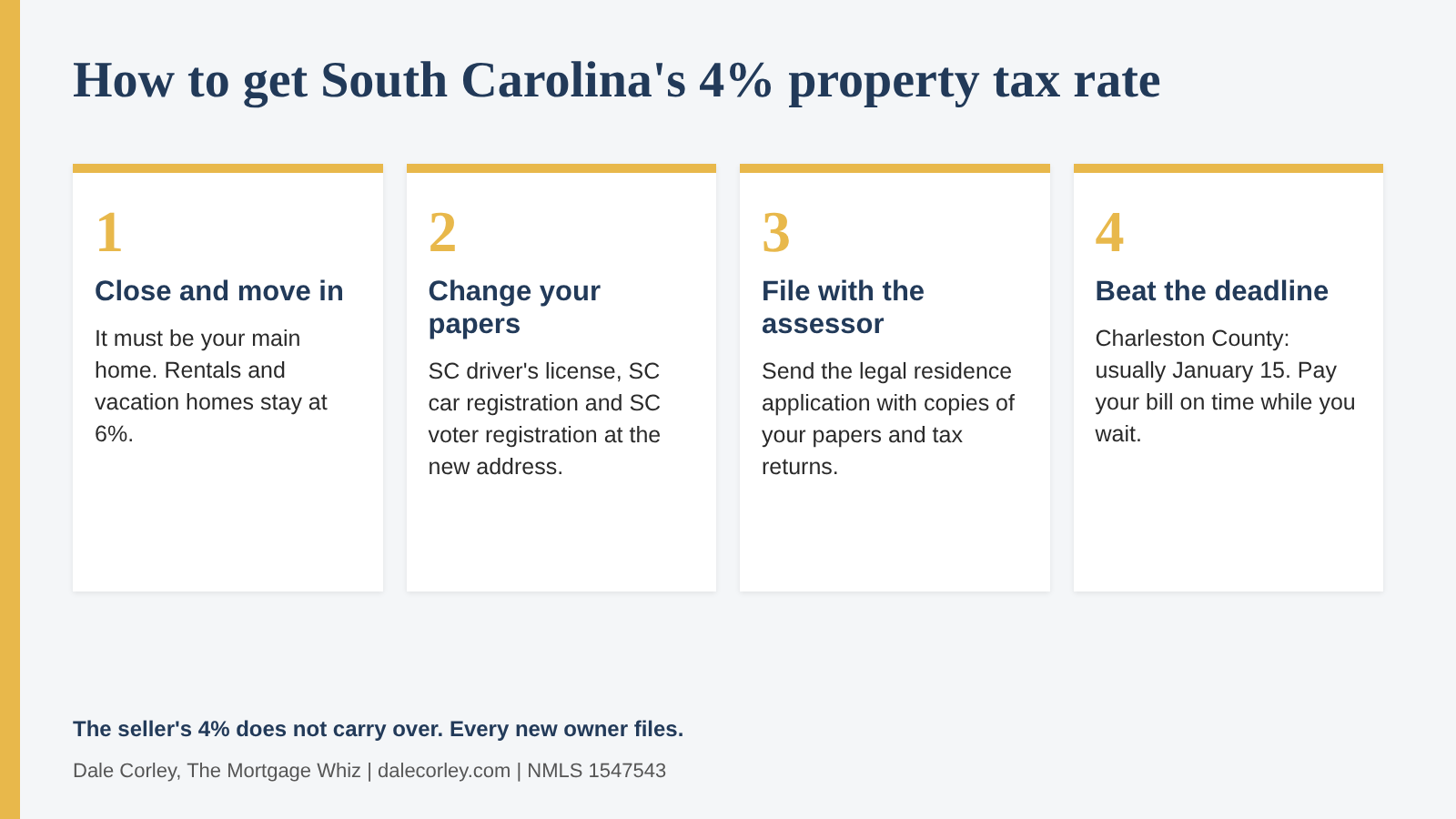 Steps 1 and 2 come first, because the application asks for proof of both.
The seller’s 4% doesn’t carry over to you, so file even if the seller had it. Questions go to the Charleston County Assessor’s Office at 843-958-4100.
What’s the difference between the 4% and 6% rate?
South Carolina assesses your legal residence (your main home) at 4% of its value for property tax. Any other home, like a rental or second home, is assessed at 6%. That percentage is called the assessment ratio. The county multiplies your home’s value by it, and the result is your assessed value, the number your tax bill is based on.
The 4% rate saves you money in two ways. First, your assessed value is a third smaller. Second, a state law known as Act 388 says a home taxed at 4% pays no school operating tax. You still pay the school debt tax, which pays off school building bonds, plus county and city taxes.
Local tax rates are set in mills. A mill is $1 of tax for every $1,000 of assessed value. This is Charleston County’s October median home at both rates. It’s an example, not a tax bill.
| Same $726,500 home | Legal residence (4%) | Not your main home (6%) |
|---|---|---|
| Assessed value | $29,060 | $43,590 |
| School operating tax (142.5 mills in 2025) | $0 | About $6,212 a year |
| School operating tax per month | $0 | About $518 |
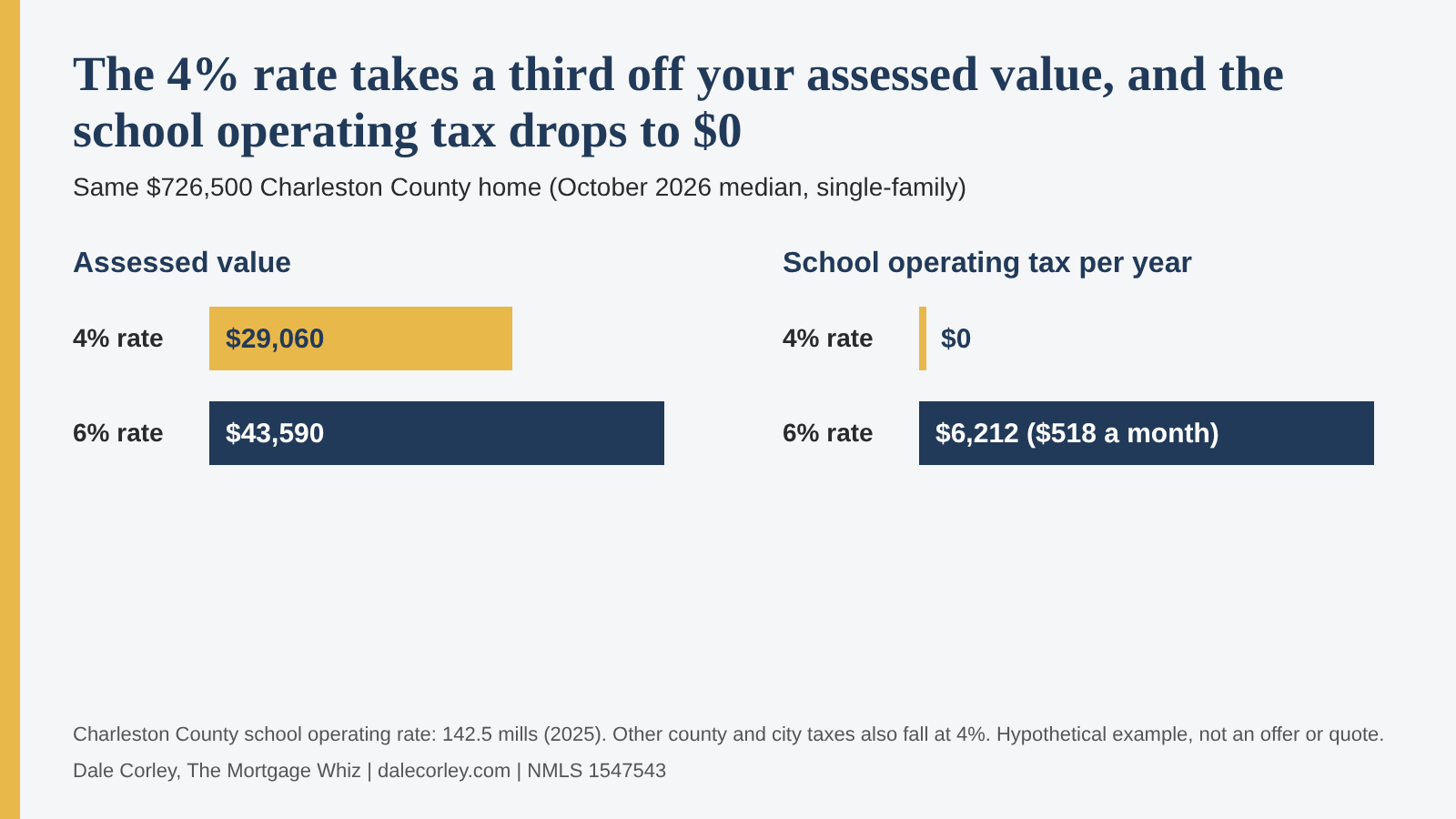 Charleston County’s 2025 school operating rate, as reported by the Post and Courier.
The table shows only the school operating tax, because it’s the piece that drops to zero. Your county, city and other taxes are figured on the smaller 4% assessed value too, so the real difference is bigger. Your rates depend on your address.
When is the deadline, and what if I close in December?
In Charleston County, the deadline is usually January 15. State law says to file before the first penalty date, the first day late fees start on your tax bill. The Assessor can’t waive it, and if you file late, you lose 4% for that tax year.
A late-year closing can still count. State law says a home that qualifies for any part of the year gets 4% for that whole year. If you move in within 90 days of buying, 4% applies back to the day you bought it. That year’s bill may still be in the seller’s name, though. If you close in December, call the Assessor’s Office to confirm which tax year you can claim.
Late penalties on the bill can’t be waived either. If your bill arrives at 6% while your application is pending, pay it on time. Send the county’s refund request with your application, and if you’re approved, the county refunds the difference.
What papers do out-of-state buyers need?
You need proof that South Carolina is now your home. Charleston County asks for copies, never originals, of these South Carolina papers at your new address:
- Driver’s license or ID card
- Vehicle registration
- Voter registration
It also asks for your tax returns:
- Federal return: the first two pages of Form 1040 and Schedules 1, A, C and E. Black out Social Security numbers, account numbers and income amounts.
- South Carolina return: the first three pages
- Your spouse’s documents and signature, if you’re married
If you haven’t filed a South Carolina return yet, send your most recent return from your old state. Active-duty military buyers also send their military ID, orders and leave and earnings statement. If you’re missing a document, the form lets you send a written explanation. I’d rather you call the Assessor’s Office with a question than have the county send your application back.
One more rule: nobody in your household can claim 4% on another home. Your household means you, your spouse and any children under 18 you claim, or could claim, as dependents. If you still own a home in South Carolina, only one of them can be your legal residence.
How is the Charleston market for buyers right now?
You have time to shop. Across the Charleston Trident area, homes took a median of 53 days to sell in October, according to the Charleston Trident Association of Realtors. There were 3.6 months of supply, meaning the homes for sale would last 3.6 months at today’s pace of sales. More supply gives buyers more room to negotiate.
| October 2026 | Charleston Trident area, all homes | Charleston County, single-family |
|---|---|---|
| Median price | $445,239 | $726,500 |
| Homes sold | 1,312 | 434 |
| Days on market | 53 (median) | 44 (as reported) |
People keep coming. The Census Bureau says South Carolina grew faster than any other state from 2024 to 2025, up 1.5%.
When a home has been listed for a while, I’d ask the seller for a credit before a price cut. A seller credit is money the seller pays toward your closing costs or a lower rate. For about the first 12 to 13 years, a credit puts more money in your pocket than the same dollars off the price. My seller credits playbook shows how to ask and how much each loan allows.
You can also borrow a little more in 2027. The Federal Housing Finance Agency (FHFA) set the 2027 conforming loan limit at $855,400 in every South Carolina county, up from $832,750. That’s the largest conventional loan (a loan not backed by the government) that Fannie Mae and Freddie Mac will buy. With 10% down, you stay under it on a home up to about $950,400.
On the $726,500 median home with 10% down, the loan is $653,850. Say your rate is 6.875%, an example rate below the market average quoted here, on a 30-year fixed conventional loan. The principal and interest payment (the part that pays down your loan, plus interest) is $4,295 a month. This is an example, not a quote. Property tax and insurance go on top, and filing for 4% is what keeps the school operating tax out of it. Freddie Mac’s weekly average for a 30-year fixed loan was 7.21% in late November 2026. Your rate depends on your credit, down payment and loan. You can try your own numbers in my mortgage calculator.
Whiz Advice
- File the 4% application the week your new papers arrive. For a fall or winter closing, January 15 comes fast, and your tax bill shows up too late to remind you.
- Still own another home in South Carolina? Sort it out before you file. Your household gets 4% on only one home, and a quick call to the Assessor’s Office beats a denied application.
- Ask me to show your payment at both rates before you make an offer. The gap between 4% and 6% is big enough to change what price feels right.
Why use a mortgage broker?
A bank can only offer its own programs. As a broker with NEXA Lending, I’m not stuck with one lender, and I can shop your loan with one application and a soft credit pull option.
I frequently get calls from stressed-out borrowers and their real estate agents looking for urgent help. The closing date is coming fast, and they have just learned from their bank or lender that their loan has been denied. Imagine that added stress and anxiety on top of the already exhausting process of selling, buying and securing financing for a new home.
During our first conversation, I’ll review your two most recent years of tax returns to calculate your maximum qualifying loan amount. If that amount doesn’t get you where you want to be, we’ll talk about a non-traditional loan program that could be a better match to get you the property you want.
Many of the issues that come up in underwriting are guidelines, not a hard stop. If your loan runs into payment shock, thin credit history, or even less than two years of self-employment, an experienced loan officer can often get an underwriting exception using compensating factors.
Qualifying for the loan can be easy. Finding a loan officer with the experience to handle all the nuances is the hard part.
How do you get ready to buy in Charleston?
Here’s what you can do this week:
- Get pre-approved before you shop. A pre-approval means a lender has checked your income and credit and told you how much you can borrow. You’ll know your price range before you fall for a house.
- Get your credit cards low, ideally under 10% of your limits and no higher than 30%. On a card with a $10,000 limit, that means a balance under $1,000.
- Book a South Carolina DMV visit for the week you move in.
- Leave nothing off your loan application, and tell me your concerns up front, like a home you still own in another state.
- Send me your numbers: price range, down payment, credit score range and target closing date. My job is to help you find the loan program that fits your situation best and make sure your application is accurate.
Pick your next step:
- Ready to get pre-approved or refinance? Start your loan application. It’s the fastest way to see what you can buy.
- Have a one-of-a-kind situation? Book a 15-minute call and we’ll talk it through.
- Just have a question? Email me at [email protected] with your scenario, and I’ll write back.
I’m a mortgage broker with NEXA Lending, and I work with borrowers all over South Carolina, including Charleston. As a broker, I can shop your loan across hundreds of lenders instead of being stuck with one bank’s programs. Programs, rates and approval depend on your full file.
Sources: Charleston Trident Association of Realtors, October 2026 market report, CTAR, Charleston County October 2026, South Carolina Code, Section 12-43-220, South Carolina Code, Section 12-37-220, Charleston County Assessor, Charleston County legal residence application, Post and Courier, Jan 4, 2026, SC Association of Counties, Property Tax Rates by County 2025, Census Bureau via South Carolina Public Radio, Jan 28, 2026, FHFA, 2027 conforming loan limits, Nov 24, 2026, FHFA 2027 county loan limit file, Freddie Mac Primary Mortgage Market Survey, Nov 25, 2026.
Dale Corley | NMLS #1547543 | Licensed in CA, CO, TX, FL, GA, NC, SC, TN, VA | This is not a commitment to lend.