
Business Owners
How Do Social Media Influencers Get a Mortgage? Here's How I Did It
Dale Corley · 11 min read
If you make your living on YouTube, TikTok, Instagram or Facebook, there’s a good chance a bank has already told you your income doesn’t count the way a paycheck does. I hear that story every week, and in my experience most of those borrowers can be approved once someone builds their file the right way before it goes to underwriting.
I’m a mortgage broker, so I shop your loan across hundreds of lenders and you don’t have to. Below is a real deal I closed in 2026 for a Miami social media influencer and musician, the reasons her bank turned her down, and the moves that got her approved.
Key takeaways
- The trouble is rarely how much a creator earns. It’s how the tax returns are read and how the file is put together before an underwriter sees it.
- Underwriters need to believe your income will keep coming, which is hard to show when it comes from sponsors, affiliate links and platform payouts.
- Lenders usually want two years of self-employment. After five years in the same field, they can often use just one year of tax returns, which can raise your qualifying income a lot. Many loan officers never check.
- A CPA letter request shouldn’t land on your desk. A good loan officer pushes back and clears it another way first.
- A bank statement loan is the backup plan, not the first move, because it usually costs more.
On this page: Why it’s hard · Her story · How I got her approved · One year vs two · CPA letters · What it saved her · If returns don’t work · Whiz Advice
Why is it so hard for influencers to get a mortgage?
A lender doesn’t care whether your money comes from a paycheck, brand deals or AdSense. It cares whether it can document that money and count on it continuing. Creators run into five problems, and the borrower in this story ran into four of them.
Most creators are newer than the two-year rule. Being a creator became a real career during and after the pandemic, so a lot of influencers are only a year or two in. Year one is learning the ropes. Year two is often the breakout, with more money than they’ve ever made, and that’s when they’re ready to stop renting or move out of their parents’ house. The catch is that lenders usually want two years of self-employment, and many creators have never heard that rule until a bank turns them down.
Write-offs shrink your income on paper. A good CPA deducts your equipment, travel, software and studio costs, and depreciates big purchases over several years. That lowers your taxes, but the lender starts from the income left after those deductions, so you can earn a lot and still show a small number on the line that counts.
Your income has to look like it will keep coming. Fannie Mae’s rules say a lender must be able to reasonably expect your income to continue, and income with a known end date has to be expected to last at least three more years. A sponsor that pays you to spotlight a product this quarter, or an affiliate deal that could end next month, makes some underwriters nervous. The fix is showing the pattern behind the deals: years of steady deposits from many sources, even if the names on the checks change. Income that’s rising is fine. Income that’s falling is what worries an underwriter.
Your business can look newer than it is. Many creators earn for years as sole proprietors before they form an LLC. If the loan officer only looks at the LLC paperwork, a five-year business looks two years old.
The underwriter asks for CPA letters. These are letters from your accountant confirming you’re still in business, how long you’ve been in business or why something was written off. Most CPAs won’t sign them, and I cover what to do about that further down.
How did a Miami influencer buy a condo after her bank said no?
She was a social media influencer and musician in her late 20s who earned from YouTube, TikTok, Instagram and Facebook, along with affiliate marketing, brand sponsorships and music sales. All told, she had about a dozen income streams, and she had built every one of them from scratch.
She wanted to buy a condo in Miami for around $600,000. She had excellent credit and could have put down as little as 5%, but she chose 20% so she would never pay mortgage insurance.
Her dad referred her to his bank, and she spent about a week filling out the application, sending documents back and forth and waiting on calls that weren’t returned. Then the bank told her that her tax returns didn’t show enough income to approve her. By that point she was under contract with $10,000 in earnest money at stake and only two weeks to clear her financing contingency, and even her real estate agent said that if the bank couldn’t do it, she didn’t know who could. She was frustrated and worried when she found me through a Google search for a mortgage broker who specializes in self-employed borrowers.
 Illustration only, not the borrower’s home. Sadly, the sunset doesn’t come with the mortgage.
How did The Mortgage Whiz get her approved?
Most loan officers would have moved her straight to a bank statement loan. I didn’t, because that would have cost her more every month. Her file had layers, and each fix uncovered the next one. I peeled them back one at a time so the underwriter would see a clean, documented story the first time they opened it, and the last layer is what saved the deal:
- I checked her tax returns before anything else. I reviewed what the bank had tried and ran the numbers on two years of returns, which confirmed they didn’t qualify her and showed me where the real problem was.
- I proved five years in business, even though her LLC was under two years old. She had been earning online as a sole proprietor long before she formed the LLC. Five years and one month earlier, she had made about $100 selling her music online. It was small, but it was the same line of work, and her early receipts proved it.
- I showed her income would keep coming. Instead of letting the underwriter judge a dozen sources one at a time, I showed years of steady earnings across all of them.
- I proved her depreciation was a real business expense. The underwriter didn’t believe a large piece of equipment she had depreciated was used in her business, so I found it in the background of one of her videos and sent it in. The underwriter reversed and added the depreciation back to her income.
- I cleared three CPA letter requests without her CPA. The details are a little further down.
- Then I used the rule that saved the deal: one year of tax returns. Once a business has been running at least five years, Fannie Mae and Freddie Mac both allow a lender to use only the most recent year instead of averaging two. Because I work with self-employed borrowers every day, I knew to look for it. That one rule kept her on a conventional loan instead of a bank statement loan.
- I hit her deadline. She was approved inside her two-week financing contingency with no extension, and we reached clear to close in 16 days.
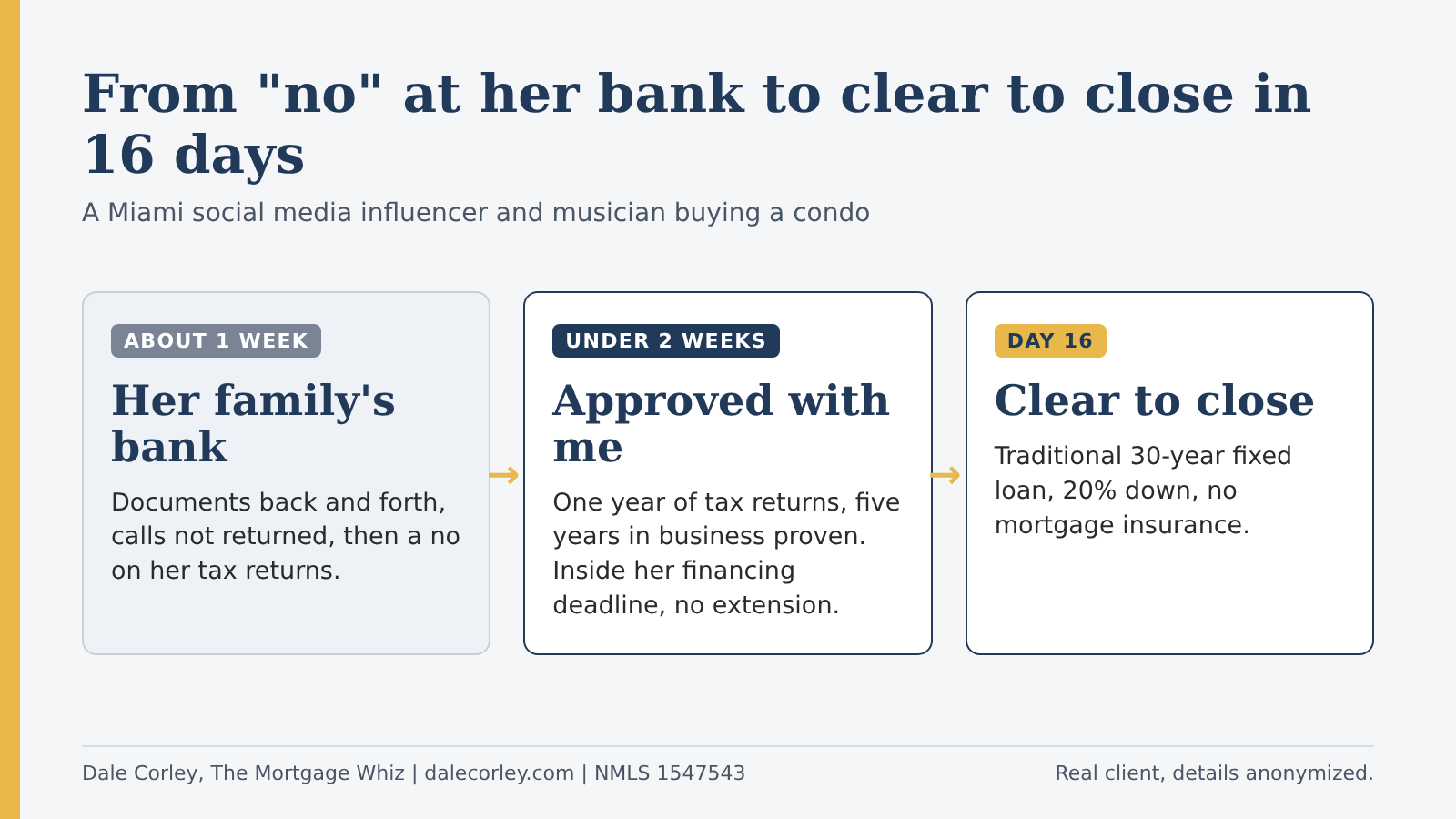 From a no at her bank to clear to close in 16 days.
Why does one year of tax returns beat two?
Normally a lender averages your last two years of tax returns. If your business grew fast, that average drags your income down. Here’s an example with round numbers, not her actual figures, for a creator whose CPA wrote off half of what they earned each year:
| Older year | Most recent year | |
|---|---|---|
| What they earned | $100,000 | $500,000 |
| What the tax return shows after 50% write-offs | $50,000 | $250,000 |
- Two-year average: $150,000 a year, or $12,500 a month to qualify with.
- One year of returns: $250,000 a year, or $20,833 a month to qualify with.
That’s 67% more qualifying income, an extra $8,333 a month. For her, the extra income from using one year is what let her qualify for the full monthly payment on the condo, including the HOA dues, property taxes and homeowners insurance.
A jump like that is fine because the income is rising. If it were falling, the underwriter would worry about the trend instead.
One honest note if you’re only in your second year: the one-year rule needs five years in the same line of work, so your two years will be averaged. That’s often where a bank statement loan fits better, because it looks at your last 12 months of deposits. I cover that option below.
Why do underwriters ask for CPA letters, and how do you get around them?
Underwriters ask for CPA letters because a letter covers them. With a CPA’s signature in the file, the underwriter doesn’t have to dig any further. The problem is that most CPAs won’t write these letters, because they don’t want to be on the hook for a bank’s lending decision, and fewer are willing every year.
That puts the borrower in a terrible spot. You get a list of conditions, you see “CPA letter” on it, your CPA says no, and now you think the whole loan is falling apart over a piece of paper. It shouldn’t ever get that far.
A good loan officer reads those conditions before you do and goes back to the underwriter first. The question I ask is simple: “We can’t get a CPA letter, so what other documents will clear this?” There’s almost always another way. I call it fighting the underwriter before I fight the borrower.
Here’s how that worked for her. The underwriter wanted three letters from her CPA:
- One saying she was still in business and making money. I cleared it with her live social media channels, the business software she runs on and her recent bank deposits.
- One confirming five years in business. Her early receipts already proved it.
- One explaining why the equipment was depreciated. I took that one to senior underwriting. In my view, it isn’t an underwriter’s job to second-guess a tax return the IRS has already accepted. Senior underwriting agreed and waived the condition.
She never had to ask her CPA for a thing.
How much did staying on a traditional loan save her?
Staying on a traditional 30-year fixed loan saved her $476 a month compared with the bank statement loan she would have needed otherwise, because bank statement pricing was running about 1.5 percentage points higher at the time. On top of that, an active 1-0 buydown promotion (a lender credit that lowers the rate for the first year) brought her first-year rate down by a full point, which saved her about $306 a month in year one.
| How long she keeps the loan | Conventional instead of bank statement | 1-0 buydown | Total saved |
|---|---|---|---|
| 1 year | $5,712 | $3,672 | $9,384 |
| 5 years | $28,560 | $3,672 | $32,232 |
| 10 years | $57,120 | $3,672 | $60,792 |
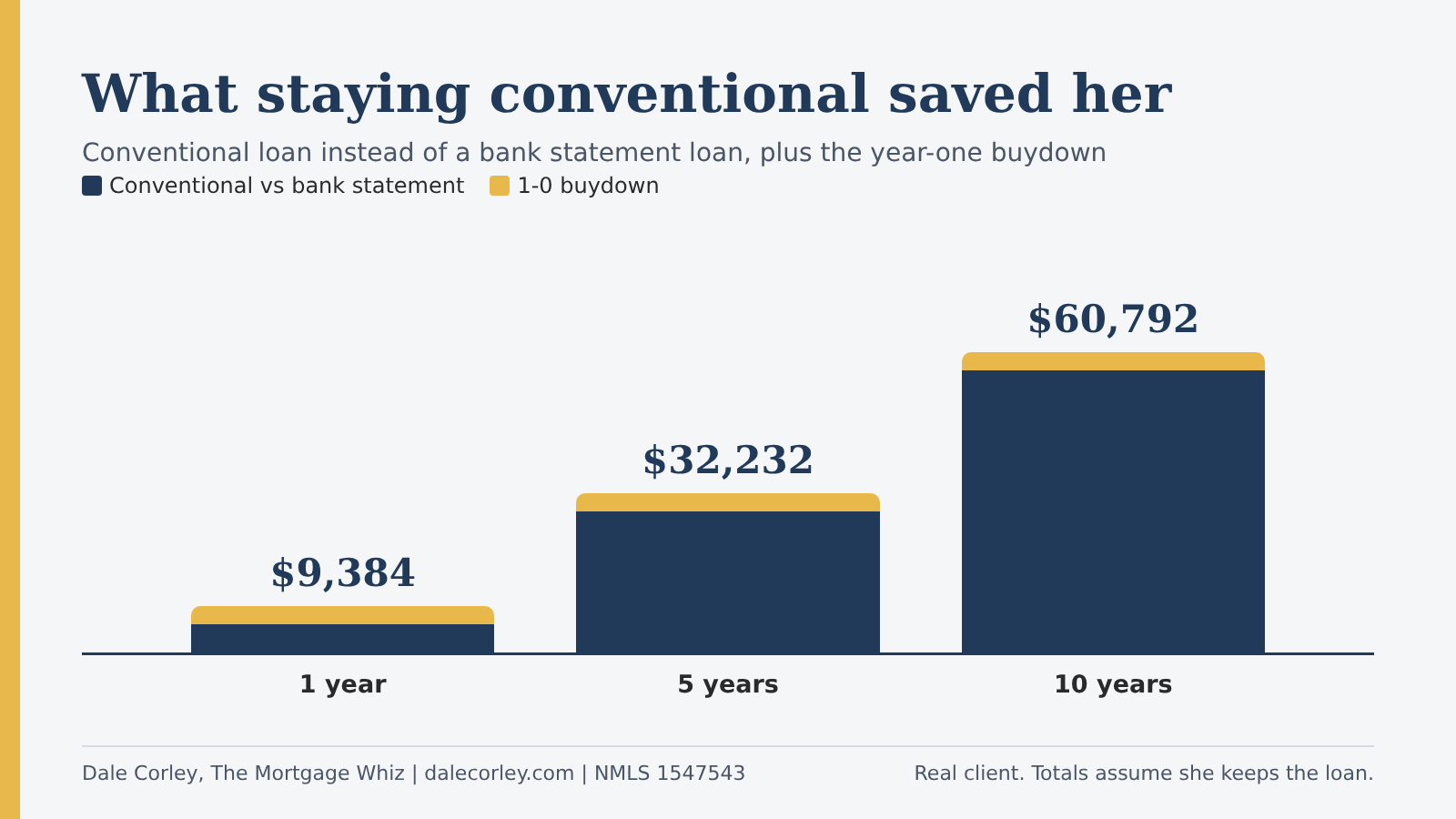 Based on the $476 monthly difference at closing for as long as she keeps the loan, plus the year-one buydown.
What if your tax returns don’t work?
Then a bank statement loan is the next stop, and for many YouTubers and TikTokers it’s a great fit. Instead of tax returns, the lender looks at 12 months of your personal or business bank statements and counts your deposits, so your write-offs don’t work against you.
Most lenders call these non-QM (non-traditional) loans. A Qualified Mortgage, or QM, is the CFPB’s category for a loan with safer features that make it more likely you can afford it. A non-QM (non-traditional) loan sits outside that box but still has to meet the federal ability-to-repay rule. It just proves income with different documents. Because the lender takes on more risk, the rate typically runs about 1% to 2% higher than a traditional loan, and it varies by file and market.
You can read more on my bank statement loan page or compare every option on my self-employed mortgage options page.
What nuances do most loan officers miss?
| What most people think | What I see | Why it matters |
|---|---|---|
| Sponsorship and affiliate income is too short-term to count. | A long record of deposits across many sources can show the income is likely to continue. | Your income gets counted instead of thrown out. |
| Bank statement loans take years of statements. | 12 months of personal or business statements is all it takes. | Less paperwork and a faster approval. |
| Personal and business statements count the same. | Personal statements can count deposits at 100%, while business statements are reduced by an expense factor, often about 50%. | The right account can mean a bigger approval. |
Whiz Advice
- Ask your loan officer what order they checked things in. If they went straight to a bank statement loan without reading your tax returns, ask them why.
- Keep your early proof. First invoices, platform payout emails and sales receipts can prove years in business that your LLC paperwork can’t.
- Talk to me before your CPA files next year’s return. I’m not giving tax advice, but knowing which year a lender will use can help you and your CPA plan.
- Call me the day a bank goes quiet, not the day before your contingency runs out. The more time I have, the more options you keep.
Why use a mortgage broker?
I shop your rates with other lenders, so you don’t have to.
Shopping for a mortgage on your own means applying again and again, sending the same documents over and over, and waiting on every quote. I do that part for you, with one application.
What you get when you work with me:
- One application, one credit pull. I compare hundreds of lenders for you, including most of the big banks and big lenders.
- More loan options than one bank can offer. VA, jumbo, bank statement, DSCR and other non-QM (non-traditional) loans. A single bank can only offer its own programs.
- Pricing from a large wholesale platform. I’m a mortgage broker with NEXA Lending, the largest brokerage in the country by loan officer headcount. In my experience, that volume helps me get wholesale pricing that many banks can’t match.
- Help when your file isn’t standard. If you’re self-employed, have unusual income or have a lower credit score, I know which lenders fit.
- A real person from start to finish. I answer your questions and make sure your application is accurate, so there are no surprises later.
How do you get ready to buy a house as a content creator?
Here’s what you can do this week:
- Pull your last two years of tax returns and write down the date you first earned money online, even if it was before your LLC.
- Gather 12 months of bank statements from the account where most of your income lands, in case we need plan B.
- Get your credit cards low, ideally under 10% of your limits and no higher than 30%, so your debts look small next to your income.
- Get pre-approved before you shop. Most buyers find the home first and scramble for the loan second, so flip that order.
- Send me your numbers. My job is to help you find the loan program that fits you best and make sure your application is accurate.
Pick your next step:
- Ready to get pre-approved? Start your loan application. It’s the fastest way to find out what you can buy.
- Have a one-of-a-kind situation? Book a 15-minute call and we’ll talk it through.
- Just have a question? Email me at [email protected] with your scenario, and I’ll write back.
I’m a mortgage broker with NEXA Lending, and I work with borrowers in all nine states where I’m licensed (CA, CO, TX, FL, GA, NC, SC, TN, VA). Programs, rates and approval depend on your full file. This is educational and not tax or legal advice.
Last reviewed October 27, 2026
Sources: Fannie Mae Selling Guide B3-3.1-01, general income information (continuance of income), Fannie Mae Selling Guide B3-3.5-01, underwriting factors and documentation for a self-employed borrower, CFPB, what is a qualified mortgage, National Mortgage Professional, NEXA Lending Signals The End Of “Brokers Are Better”, Oct 2, 2025.
Dale Corley | NMLS #1547543 | Licensed in CA, CO, TX, FL, GA, NC, SC, TN, VA | This is not a commitment to lend.