
Mortgage Tips
Assumable Mortgage Playbook: How to Take Over a Seller's Low Rate
Dale Corley · 8 min read
Yes, you can often assume a mortgage when the seller has an FHA or VA loan and you qualify. You take over their rate, their balance and their remaining years, and you pay the seller the difference between the price and the loan.
I’m a mortgage broker, so I shop hundreds of lenders and you don’t have to. Send me the seller’s loan type, balance and rate, and I’ll show you the assumption next to a new loan. This guide covers which loans can be assumed, what it saves, how much cash it takes and how it works.
Rates are why this matters now. The 30-year fixed rate averaged 7.18% the week of November 5, according to Freddie Mac. Realtor.com’s second-quarter data, reported by HousingWire in October, put 65.6% of outstanding mortgages under 5%. Many sellers hold a loan far below today’s rate, and some of those loans can pass to the next owner.
Key takeaways
- FHA loans can be assumed. So can VA loans. Most conventional fixed-rate loans can’t, except in cases like a death or a divorce.
- In my example, taking over a $360,000 loan at 3.0% costs $732 a month less than a new loan at 7.18%.
- You pay the seller the gap between the price and the loan balance. On a $600,000 home with that loan, the gap is $240,000.
- You don’t have to be a veteran to assume a VA loan. The seller’s VA benefit stays tied to the loan unless a qualified veteran takes it over.
- I shop hundreds of lenders so you don’t have to, and I can price an assumption against a new loan before you make an offer.
On this page: Can you assume a mortgage? · What it saves · Cash you need · How it works · VA loans · Finding a home · Whiz Advice · Get ready
Can you assume a mortgage?
It depends on the seller’s loan type. To assume a mortgage means to take over the seller’s existing loan, with its rate and terms, instead of getting a new one.
| Seller’s loan | Can a buyer assume it? | What it takes |
|---|---|---|
| FHA | Yes. HUD says all FHA-insured loans are assumable | You plan to live in the home (for loans closed on or after December 15, 1989), and the servicer reviews your credit and income |
| VA | Yes. The buyer doesn’t have to be a veteran | The loan is current, the servicer approves your credit and income, and you pay a funding fee at closing |
| USDA | Ask first. See below | The buyer must be an eligible applicant and USDA must approve |
| Conventional fixed-rate | Generally no | Only special cases, such as a death, a divorce or a transfer to a spouse or child |
| Conventional adjustable-rate (ARM) | Can be | The rate can adjust, so check when the low rate ends |
The servicer is the company that collects the seller’s payment. It is the one that says yes or no.
Fannie Mae’s homeowner site lists USDA loans with FHA and VA as loans that may be assumed. USDA’s own servicing handbook describes assumptions in limited cases, mostly transfers between family members, and says the buyer must be an eligible applicant. I couldn’t confirm a clean path for a stranger buying a USDA home, so ask the servicer first.
How much can taking over a low rate save you?
Here is one example, not a quote. You buy a $600,000 home. The seller’s loan has a $360,000 balance at 3.0% with 25 years left. You pay the seller the $240,000 gap in cash. A buyer with a new 30-year loan at 7.18%, the Freddie Mac average, also borrows $360,000 and also puts $240,000 down. So the only thing that changes is the loan.
| Take over the seller’s loan | New 30-year loan | |
|---|---|---|
| Rate | 3.0% | 7.18% |
| Loan amount | $360,000 | $360,000 |
| Monthly principal and interest | $1,707 | $2,439 |
| Interest in the first year | $10,666 | $25,733 |
| Interest in the first five years | $50,249 | $125,843 |
You save $732 a month, which is $8,779 a year. Over five years, you pay $75,594 less interest. Principal and interest is the loan payment before taxes and insurance. I compared the assumption with a new 30-year loan, which has the lower payment of the new-loan choices, so the savings aren’t stretched.
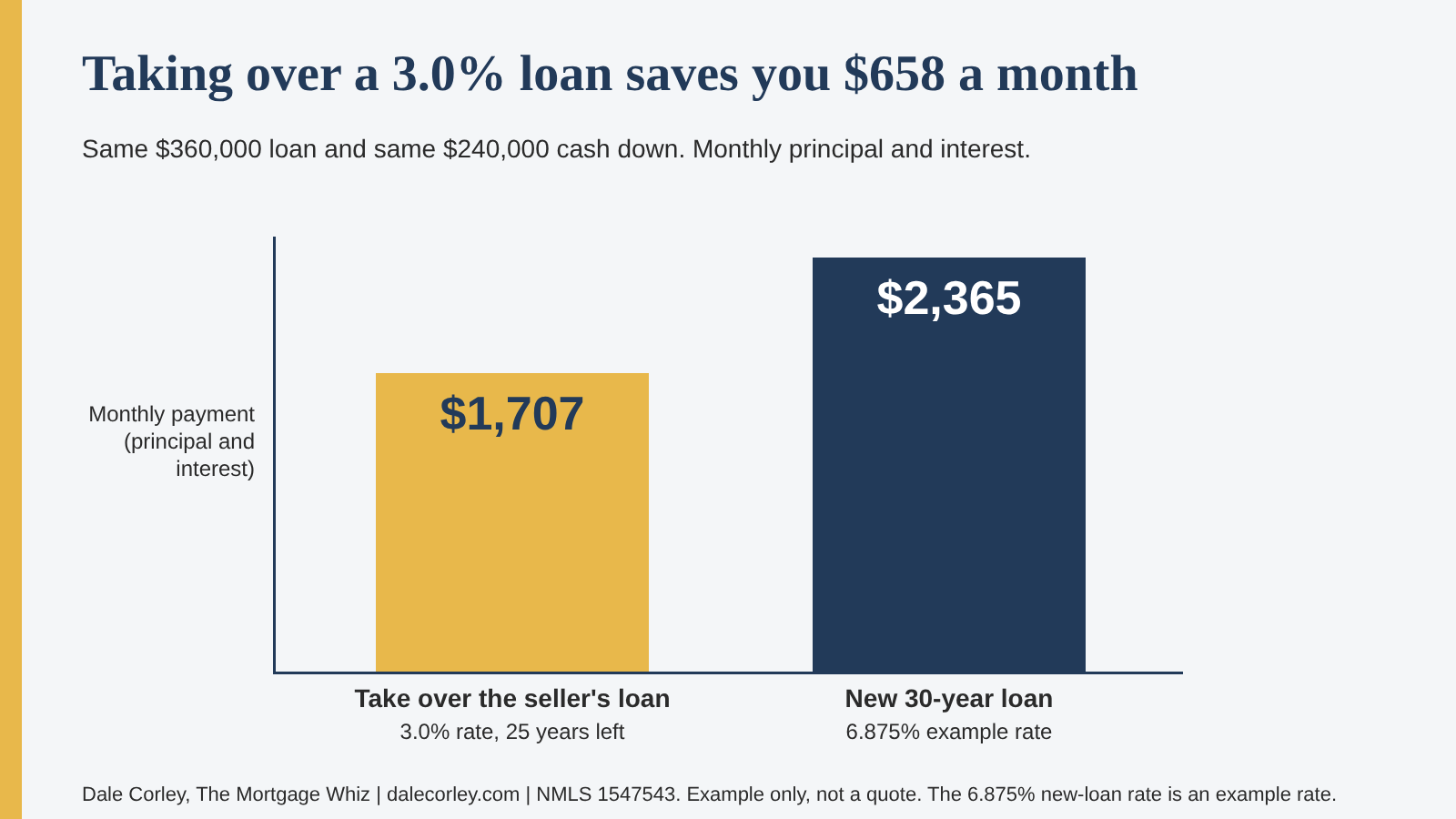
Same $360,000 loan and same $240,000 cash down. Example only. Rate source: Freddie Mac, November 5, 2026.
The lower the seller’s rate, the more the assumption is worth. Here is the same $360,000 loan at other rates.
| Seller’s rate | Monthly payment | You save each month vs. the new loan |
|---|---|---|
| 3.0% | $1,707 | $732 |
| 4.0% | $1,900 | $539 |
| 5.0% | $2,105 | $334 |
| 6.0% | $2,319 | $119 |
A 5% loan still saves real money. At 6%, a new loan with a seller credit may fit you better.
How much cash do you need to assume a mortgage?
You need the gap between the price and the loan balance, plus fees. On a $600,000 home with a $360,000 loan, that gap is $240,000, or 40% of the price. This is the catch with an assumption. It fits buyers with real cash, and the seller’s equity decides how much.
Where the cash comes from matters. Move-up buyers often use the equity from selling their current home. Others use savings. You can also borrow against a home you already own with a HELOC, which is a credit line backed by your home. My Home Equity Playbook shows what that costs.
HUD sets no minimum down payment for an FHA assumption, and you can assume 100% of the loan balance. The seller still expects the gap to be paid. The fees are small next to it:
- VA: a funding fee of 0.5% of the loan balance, paid at closing and not added to the loan, unless you’re exempt. On $360,000 that’s $1,800. The servicer can also charge an assumption fee of up to $300.
- FHA: a processing fee of up to $1,800, plus costs like a credit report. The seller can contribute toward your actual closing costs.
Sellers know a low rate has value. In my experience, some will want it reflected in the price, so don’t assume the gap is fixed.
How does an assumption work, step by step?
- The seller tells their servicer. For VA, the loan must be current, or be brought current at or before closing. Cash at closing can do it.
- You apply with the servicer. For VA, the paperwork is the same as for a VA purchase. For FHA, an underwriter reviews you by hand under the normal FHA rules.
- The servicer decides. For VA, the servicer has 45 calendar days after a complete application to say yes or no.
- You close. You pay the seller the gap and pay the fees.
- The seller is released. For FHA, the servicer prepares HUD form 92210.1, which releases the seller. For VA, the assumption includes a release of liability. This only happens after the servicer approves you.
Do you have to be a veteran to assume a VA loan?
No. VA’s rule is that a servicer must approve an assumption when the loan is current, you agree to take full liability, and you meet VA’s credit standards. You don’t have to be a veteran.
There is a catch for the seller. When a non-veteran assumes the loan, the seller’s VA benefit, called entitlement, stays tied to that loan until it’s paid off. If you’re an eligible veteran with enough entitlement who will live in the home, you can substitute your own, and the seller gets theirs back. In my experience, a veteran seller who wants to buy another home with a VA loan will often prefer that. My VA loan page explains entitlement in more detail.
How do you find a home with an assumable loan?
You ask. The listing agent can ask the seller for the loan type, the balance, the rate and whether the loan is current, and the seller can send a recent mortgage statement. Don’t count on a listing to say. Ask your agent to find out before you tour.
If the answer is FHA or VA, send me the numbers. If it’s conventional, a buyer usually can’t take it over. My FHA loan page shows what FHA buyers need.
Whiz Advice
- Price the assumption against a new loan with a seller credit or a rate buydown. If the seller’s rate is 5% or higher, the new loan may win. The table above shows where the savings get thin.
- Never take over payments without the servicer’s approval. Fannie Mae’s servicing rules treat buying a property “subject to” the existing mortgage as a transfer of ownership that the servicer can act on. Do it with approval, in writing.
- Make your offer depend on the servicer’s approval. Then you aren’t stuck if the servicer says no.
- Build the cash plan before you shop. Add up savings, the expected equity from your current home and any home equity you could borrow against. Compare the total with the gap.
- Write a closing date that allows for the review. For a VA loan, the servicer has 45 calendar days after a complete application.
- Sellers and agents: ask for the release in writing. Fannie Mae says a seller generally isn’t released unless the new borrower qualifies.
Why use a mortgage broker?
I shop your rates with other lenders, so you don’t have to.
Shopping for a mortgage on your own means applying again and again, sending the same documents over and over, and waiting on every quote. I do that part for you, with one application.
What you get when you work with me:
- One application, one credit pull. I compare hundreds of lenders for you, including most of the big banks and big lenders.
- More loan options than one bank can offer. VA, jumbo, bank statement, DSCR and other non-QM (non-traditional) loans. A single bank can only offer its own programs.
- Pricing from a large wholesale platform. I’m a mortgage broker with NEXA Lending, the largest brokerage in the country by loan officer headcount. In my experience, that volume helps me get wholesale pricing that many banks can’t match.
- Help when your file isn’t standard. If you’re self-employed, have unusual income or have a lower credit score, I know which lenders fit.
- A real person from start to finish. I answer your questions and make sure your application is accurate, so there are no surprises later.
How do you get ready to assume a mortgage?
Here’s what you can do this week:
- Count your cash. Write down your savings, your expected equity and any home equity you could borrow against. That is your number for the gap.
- Get pre-approved before you shop. The servicer reviews you like a new loan, so your credit and income matter. Most people find the house first, and that order is backwards.
- Get your credit cards low. Under 30% of your limits helps, and under 10% is better.
- Ask your agent for FHA and VA listings. Have them ask each seller for the loan type, balance and rate.
- Send me your numbers. My job is to help you find the loan program that fits you best and make sure your application is accurate. Tell me your price range, your cash and any seller loan details, and I’ll run the assumption against a new loan.
Pick your next step:
- Ready to get pre-approved or refinance? Start your loan application. It’s the fastest way to see your options.
- Have a one-of-a-kind situation? Book a 15-minute call and we’ll talk it through.
- Just have a question? Email me at [email protected] with your scenario, and I’ll write back.
I’m a mortgage broker with NEXA Lending, and I work with borrowers in all nine states where I’m licensed (CA, CO, TX, FL, GA, NC, SC, TN, VA). As a broker, I can shop your loan across hundreds of lenders. Programs, rates and approval depend on your full file.
Last reviewed November 6, 2026
Sources: VA Circular 26-23-10, VA assumption updates, May 2023, HUD Handbook 4000.1, FHA assumptions, revised August 2026, HUD, are FHA-insured mortgages assumable, January 2026, Fannie Mae, changing or transferring ownership of a home, Fannie Mae Servicing Guide D1-4.1-01, USDA HB-1-3555 Chapter 17, transfer and assumption, Freddie Mac Primary Mortgage Market Survey, November 5, 2026, HousingWire, Realtor.com Q2 2026 lock-in data, Oct 23, 2026
Dale Corley | NMLS #1547543 | Licensed in CA, CO, TX, FL, GA, NC, SC, TN, VA | This is not a commitment to lend.