
VA Loans
How Hard Is It to Get a VA Loan? The Process, Step by Step, and the Test Nobody Mentions
Dale Corley · 7 min read
Not very hard. If you’ve ever gotten a conventional mortgage, your part of a VA loan will feel almost the same, and most of the extra VA paperwork happens on my side of the desk.
Last reviewed October 8, 2026
I hear the same worry from veterans all the time. “It’s a government program, so it’s going to be red tape and delays.” Here’s what the process actually looks like, what’s different, and the one VA rule that helps more borrowers than people realize.
Key takeaways
- The VA doesn’t lend you the money. It guarantees part of the loan, and a private lender funds it.
- Your lender can usually request your Certificate of Eligibility (COE) online through VA’s system.
- The paperwork you gather is the same as any mortgage: pay stubs, bank statements, tax returns.
- The VA appraisal checks the home’s condition as well as its value, and most of my states require a termite inspection statewide.
- Any VA disability rating that pays compensation waives the funding fee. It doesn’t have to be 100%.
- VA uses a second qualifying test called residual income. A strong result can carry a file with a debt-to-income ratio above 41%.
Who makes the loan · The steps · What’s different · Residual income · The math · Checklist
Who actually makes a VA loan?
A private lender does. The Department of Veterans Affairs guarantees part of the loan, which is why a lender is willing to do it with no down payment.
VA says you generally need no down payment as long as the sales price isn’t higher than the appraised value. There’s also no private mortgage insurance. Most borrowers pay a one-time funding fee instead, unless they’re exempt. I break that fee down in VA Funding Fee: What It Is and What It Is Not.
What are the steps to get a VA loan?
Five steps, and only the first one is unique to VA.
- Get your Certificate of Eligibility. This is VA’s proof that your service qualifies you. Veterans usually need a DD-214. Active-duty borrowers need a statement of service signed by their commander or personnel officer. VA says your lender may be able to pull the COE online through a system called WebLGY, and in my experience that’s how most of them get done. You can also request it yourself online or by mail, which can take longer.
- Apply and send your documents. Same as any loan. Pay stubs, W-2s or tax returns, and bank statements.
- Get under contract. Once you have a home, escrow or the closing attorney opens the file and title work starts.
- The VA appraisal. Your lender orders it through VA’s system, and VA assigns the appraiser. The appraiser sets the value and checks the home against VA’s Minimum Property Requirements.
- Underwriting and closing. The underwriter reviews your income, credit and the appraisal, clears any conditions, and you close.
The steps are the same everywhere. How fast they move isn’t. I’m aggressive about timelines, and as a broker I can usually turn a file much quicker than a large lender or a big bank. Speed is one of the things that separates me, and on a purchase with a closing date, it matters.
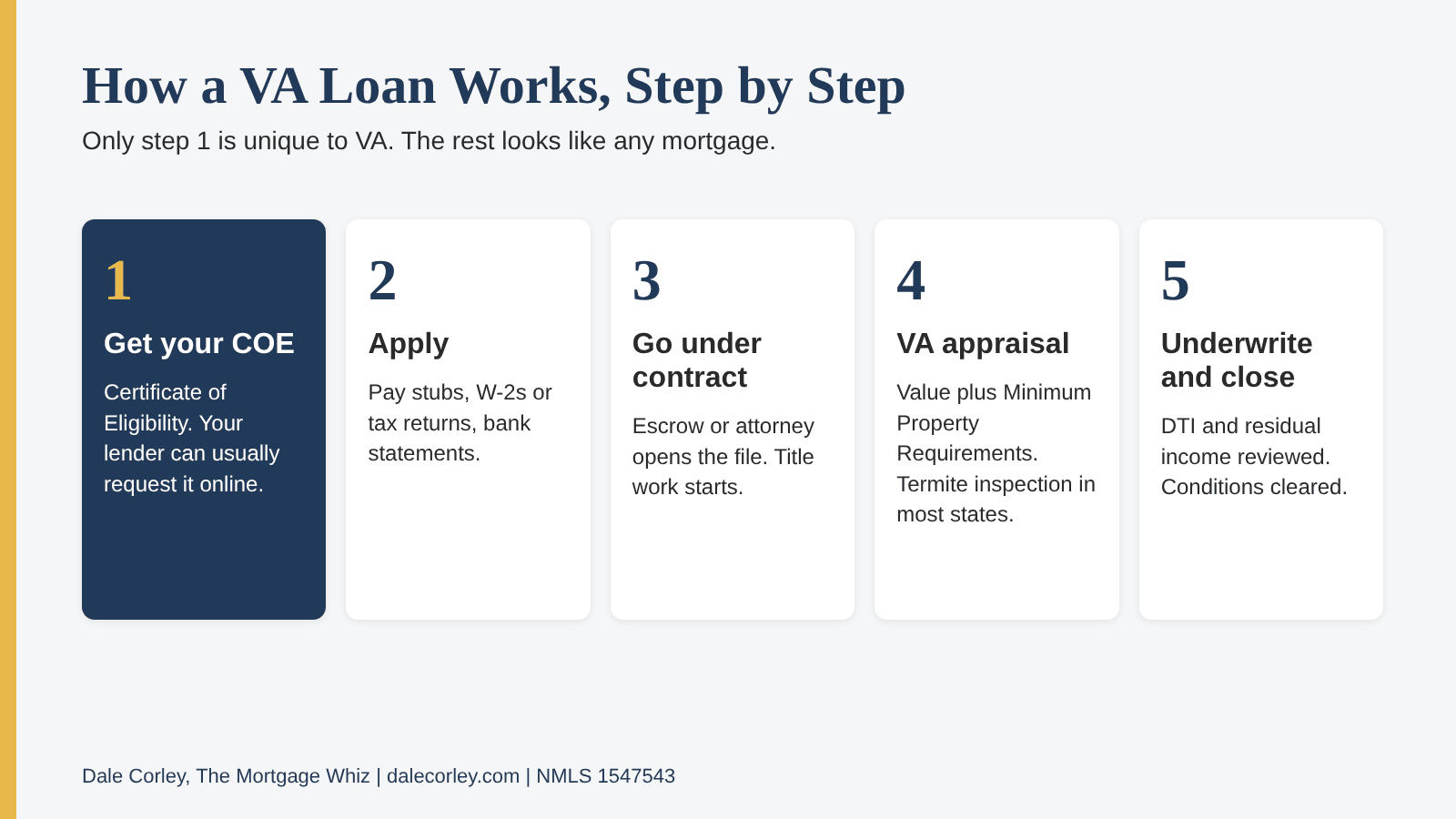 The five steps of a VA purchase. Only step 1 is unique to VA.
What’s different from a conventional loan?
Three things, and two of them are about the house, not you.
| VA loan | Conventional loan | |
|---|---|---|
| Proof of eligibility | Certificate of Eligibility required | None |
| Down payment | Generally none, if price is at or below appraised value (VA) | Varies by program |
| Mortgage insurance | None. One-time funding fee unless exempt (VA) | PMI may be required with under 20% down (CFPB) |
| Appraisal | Value plus Minimum Property Requirements | Value |
| Termite inspection | Required statewide in 8 of my 9 states (VA) | Not a loan requirement |
| Seller concessions | Capped at 4% of reasonable value (VA) | Varies |
| Qualifying tests | Debt-to-income plus residual income | Debt-to-income |
Minimum Property Requirements. VA wants the home to be safe, structurally sound and sanitary. Military.com’s VA loan coverage gives examples like a roof with useful life left, safe drinking water and hot water, and no active leaks. Conditions that affect safety or soundness generally have to be fixed before closing. Think of it as a basic inspection built into the loan. It’s not a substitute for your own home inspection, and I always tell buyers to get one.
Termite inspection. VA’s local requirements list shows a wood-destroying insect inspection is required statewide in North Carolina, South Carolina, Georgia, Florida, Tennessee, Virginia, Texas and California. In Colorado it applies only in certain counties, such as El Paso and Pueblo. Who pays for it gets settled in your purchase contract.
The COE. Covered above. It’s one more document, and usually not a hard one.
What is VA residual income, and why does it matter?
Residual income is the money left over each month after your house payment, your other debts, taxes and basic living costs. VA’s underwriting rule (38 CFR 36.4340) sets a minimum by family size and region. This is the part of a VA loan almost nobody explains, and it’s where VA can be easier than people expect.
Here are VA’s minimums for loans of $80,000 and up in my states:
| Family size | South (NC, SC, GA, FL, TN, VA, TX) | West (CA, CO) |
|---|---|---|
| 1 | $441 | $491 |
| 2 | $738 | $823 |
| 3 | $889 | $990 |
| 4 | $1,003 | $1,117 |
| 5 | $1,039 | $1,158 |
Now the part that matters. VA’s debt-to-income standard is 41%. But the same regulation says that if your ratio is above 41% and your residual income beats the guideline by at least 20%, the extra supervisory review and written justification aren’t required. Meeting both tests still doesn’t guarantee approval, because the lender looks at your full credit picture.
Put plainly: a conventional borrower at 43% or 44% debt-to-income can hit a wall. A VA borrower at the same ratio with healthy residual income often has a real path. I see veterans assume they’re “too stretched” because a bank quoted them a DTI number. That number is only half of how VA looks at you.
What does zero down actually cost you?
Here’s a hypothetical on a $400,000 home, done in a script, not by hand. To keep it apples to apples, both loans use Freddie Mac’s 30-year average of 7.40% from October 8, 2026. That survey tracks conventional loans, so it’s not a VA quote, and individual rates vary.
| Hypothetical, $400,000 purchase | Conventional, 3% down | VA, zero down, first use |
|---|---|---|
| Down payment | $12,000 | $0 |
| Funding fee (2.15%, financed) | None | $8,600 |
| Loan amount | $388,000 | $408,600 |
| Principal and interest at 7.40% | $2,686 | $2,829 |
| Monthly mortgage insurance | Likely, under 20% down | None |
Hypothetical example, not an offer or quote. Taxes and insurance not included.
Look at that honestly. The VA principal and interest is higher here because the funding fee is rolled into the loan. The VA buyer wins on two other lines. They keep $12,000 in the bank, and they skip the monthly PMI the conventional buyer would likely carry. If you receive VA compensation for a service-connected disability, the funding fee drops to zero and the VA loan amount falls to $400,000.
You don’t need a 100% rating for that. This is the one I correct most often. VA’s rule is simply that you receive compensation for a service-connected disability. Any rating that pays you compensation counts. VA also exempts you if you’re eligible for that compensation but take retirement or active-duty pay instead, if you’re a surviving spouse receiving Dependency and Indemnity Compensation, or if you’re on active duty with a Purple Heart. If a rating comes through after closing and is retroactive to before your closing date, VA says you may get the fee refunded.
Now the residual income side, same hypothetical. A family of four in North Carolina earns $9,000 a month gross and takes home $7,000. Their house payment with taxes and insurance is $3,279, other debts are $650, and estimated utilities and upkeep are $400.
- Debt-to-income: ($3,279 + $650) ÷ $9,000 = 43.7%, above VA’s 41% standard.
- Residual income: $7,000 − $3,279 − $650 − $400 = $2,671.
- VA’s minimum for a family of four in the South is $1,003. Twenty percent above that is about $1,204.
This family clears the residual income guideline by more than double. That’s the kind of file where VA’s second test does the heavy lifting.
Your next steps
- Find your DD-214 (or get your statement of service if you’re active duty).
- Gather your recent pay stubs, W-2s or tax returns, and recent bank statements. I’ll tell you exactly how many months your file needs.
- Ask whether you receive, or are eligible for, VA disability compensation. It changes your funding fee.
- Run your numbers with my VA loan calculator, then call me and we’ll check your residual income along with your DTI.
Want the full program overview first? See my VA loan page.
Quick glossary
| Term | Plain English |
|---|---|
| Certificate of Eligibility (COE) | VA’s document confirming your service qualifies you |
| DD-214 | Your discharge or separation papers |
| Minimum Property Requirements | VA’s standards that a home be safe, sound and sanitary |
| Funding fee | One-time VA charge, often financed into the loan, waived for many disabled veterans |
| Residual income | What’s left each month after housing, debts, taxes and living costs |
Getting a VA loan isn’t a bureaucratic maze. It’s a regular mortgage with a couple of extra checks, and one of those checks works in your favor.
To every veteran and service member reading this: thank you for my freedom.
I’m a mortgage broker with NEXA Lending, and I work with borrowers in all nine states where I’m licensed (CA, CO, TX, FL, GA, NC, SC, TN, VA). Programs, rates and approval depend on your full file. Call me and I’ll walk you through it.
Sources: VA, How to request a COE, VA, Eligibility for a VA home loan, VA, Purchase loan, VA, Funding fee and closing costs, VA, Local requirements for appraisers, eCFR, 38 CFR 36.4340 underwriting standards, Freddie Mac PMMS, October 8, 2026, CFPB, What is private mortgage insurance?, Military.com, The three S’s of a VA appraisal
Dale Corley | NMLS #1547543 | Licensed in CA, CO, TX, FL, GA, NC, SC, TN, VA | This is not a commitment to lend.